What is a Sanitary Ball Valve and How Does It Work?
In the pharmaceutical, food, and beverage industries, flow control is critical. You need a valve that offers high flow rates, durability, and most importantly, absolute hygiene.
This is the domain of the sanitary ball valve.
Unlike standard industrial valves that can trap bacteria, Sangyie’s sanitary ball valves are engineered for purity. But how exactly do they work, and what is the difference between the various types?
As a professional sanitary valves manufacturer, Sangyie is here to explain the essentials.
What is a Sanitary Ball Valve?
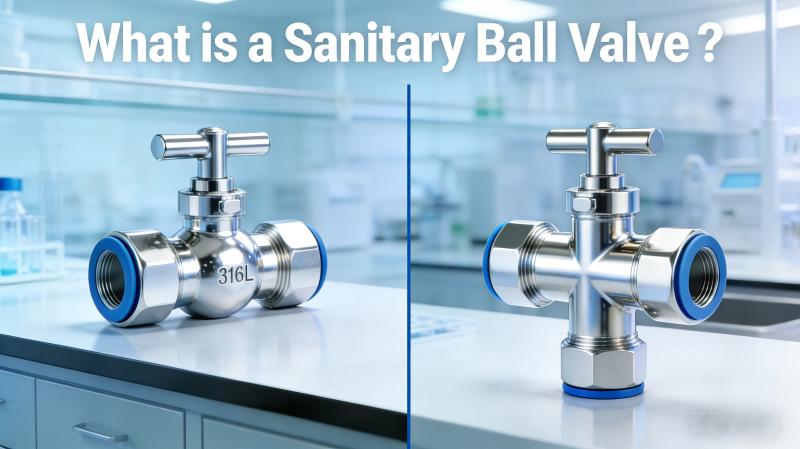
A sanitary ball valve is a flow control device that uses a pivoting, spherical ball with a hole (bore) through the center to control liquid flow. It operates with a simple "quarter-turn" (90-degree) motion.
To be classified as "sanitary" and meet 3-A or FDA standards, it must differ from hardware store valves in three key ways:
-
Material: It is made from high-grade AISI 316L Stainless Steel to resist corrosion and harsh cleaning chemicals.
-
Surface Finish: The internal surfaces are polished to Ra < 0.8μm, creating a mirror-like finish that prevents product residue from sticking.
-
Encapsulated Seats (Cavity Fillers): This is the most critical feature. Standard ball valves have a gap between the ball and the body where fluid can rot. Sangyie valves use special PTFE cavity fillers to seal this gap, making the valve bacteria-resistant and fully cleanable.
Configurations: 2-Way vs. 3-Way
Depending on your process, you will typically choose between two main configurations.
1. The 2 Sanitary Ball Valve (2-Way)
This is the most common "straight-through" valve.
-
Function: Simple On/Off control.
-
Design: It has one inlet and one outlet. Because Sangyie valves feature a Full Bore design, the hole in the ball matches the pipe size (e.g., a 2" sanitary ball valve has a full 2-inch opening).
-
Advantage: Zero flow restriction. It allows for "pigging" (cleaning with a solid projectile) to clear the line effectively.
2. The 3 Way Sanitary Ball Valve
When you need to divert flow rather than just stop it, you need a 3 way sanitary ball valve. These have three ports and come in two internal patterns:
-
T-Port: Used for mixing fluids or diverting flow to two tanks simultaneously.
-
L-Port: Used strictly for diverting flow from the center port to either the left or right port.
Why Use Sanitary Ball Valves?
Compared to butterfly or diaphragm valves, sanitary ball valves offer unique benefits for your production line:
-
High Flow Capacity: They provide the least resistance to flow, making them ideal for viscous products like syrups, creams, or tomato paste.
-
Durability: They can withstand higher pressures and temperatures (up to 180°C) compared to other sanitary valves.
-
Reliability: The robust seal ensures tight shut-off, preventing leaks even after thousands of cycles.
Why Choose Sangyie?
Sourcing valves is not just about the hardware; it's about the system integration.
At Sangyie, we are more than just a valve supplier. We manufacture a complete ecosystem of Sanitary Pumps, High-Shear Mixers, and Sanitary Fittings.
-
Integrated Quality: We ensure our ball valves connect perfectly with our pumps and tubing systems.
-
Traceability: Every 316L valve comes with full material certification.
-
Customization: Whether you need a manual handle or a pneumatic actuator for automation, we build it to your specs.
Conclusion
Whether you need a robust 2 sanitary ball valve for a CIP supply line or a versatile 3 way sanitary ball valve for product diversion, quality matters.
Don't compromise your process with generic valves. Choose Sangyie for precision-engineered, hygienic flow control solutions.
Ready to upgrade your system? Contact Sangyie today to discuss your application or view our full catalog of sanitary valves.
[Click Here to Contact Us / Visit our Website at www.sangyie.com / Email us at [info@sangyie.com]
Sangyie Technology — Engineering the Flow of Your Success.
Batch vs. Inline High Shear Mixers: Which is Best for Your Sanitary Process?
What is a Sanitary Check Valve? The Guardian of Flow Direction
Related Article

DIN 11866 is the overarching standard for aseptic systems that uses DIN 11850 as its "Series A" option.