Hygienic Sandwich vs Standard Butterfly Valve: Key Differences
In hygiene-critical industries such as food processing, dairy, pharmaceuticals, and semiconductors, maintaining a sterile and efficient fluid control system is non-negotiable. While sanitary butterfly valves are the most common choice for managing flow, engineers and procurement managers often face a critical decision: Should you choose a standard hygienic butterfly valve or a hygienic sandwich butterfly valve?
At Sangyie, as a leading manufacturer of hygienic valves, pumps, high shear mixers, and sanitary pipe fittings, we frequently help our clients navigate this exact dilemma. In this comprehensive guide, we will break down the key differences between the two, helping you make the best choice for your piping system.
What is a Standard Hygienic Butterfly Valve?
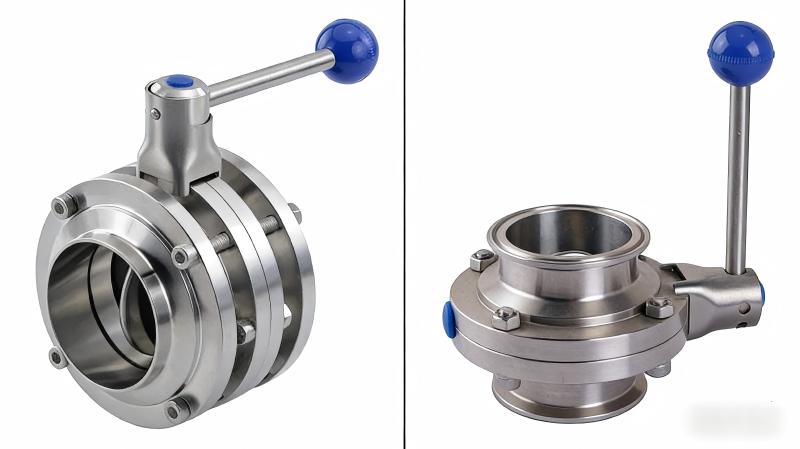
A standard hygienic butterfly valve is the traditional workhorse of sanitary processing. It typically features a simple, one-piece or standard two-piece body design connected to the pipeline via Tri-clamp, threaded, or welded ends.
Because of its straightforward design, a standard butterfly valve is highly cost-effective and perfectly suited for general hygienic applications, such as standard beverage production, brewing, and basic dairy processing, where space is ample and maintenance intervals are predictable.
What is a Hygienic Sandwich Butterfly Valve?
A hygienic sandwich butterfly valve features a unique and highly functional design. Instead of standard connections, the valve's seat and disc are "sandwiched" tightly between two separate body flanges, secured by multiple external bolts (usually four).
This compact, robust design allows the valve to be easily isolated from the pipeline. It is heavily favored in high-end industries—such as biotechnology, cosmetics, and semiconductors—where extremely tight installations and rapid maintenance are required.
Key Differences Between Sandwich and Standard Butterfly Valves
While both valves are designed to meet strict sanitary standards, their structural differences lead to distinct advantages in daily operations. Here are the 4 key differences:
1. Design and Structural Space
-
Standard Valve: Takes up standard face-to-face dimensions depending on the connection type (e.g., long welded ends).
-
Sandwich Valve: Features an ultra-compact, narrow face-to-face dimension. This makes the sandwich butterfly valve the ultimate space-saver, perfect for tight equipment skids, complex semiconductor machinery, or compact bio-reactors where every inch matters.
2. Maintenance and Seat Replacement (The Dealbreaker)
-
Standard Valve: To replace a worn-out seat (gasket), operators often need to pull the connected pipes apart or disassemble a larger section of the pipeline, which takes time and effort.
-
Sandwich Valve: This is where the sandwich design shines. By simply loosening the external bolts, the entire center section of the valve can be slid out without moving the heavy adjacent pipelines. This "drop-out" maintenance significantly reduces system downtime, a crucial factor for pharmaceutical and personal care manufacturers.
3. Pressure Resistance and Stability
-
Standard Valve: Performs exceptionally well under normal working pressures but can be sensitive to heavy vibrations.
-
Sandwich Valve: Thanks to the multi-bolt clamping mechanism, the pressure on the valve seat is distributed much more evenly. If your valve is installed close to high-vibration equipment—such as Sangyie’s sanitary pumps or high shear mixers—the sandwich valve provides superior sealing stability and minimizes the risk of leakage.
4. Cost vs. Long-Term Value (ROI)
-
Standard Valve: Lower initial purchase cost, making it ideal for projects with tight budgets and less demanding maintenance schedules.
-
Sandwich Valve: While the upfront cost is slightly higher due to the complex machining of the flanges and bolts, the long-term ROI is massive. The labor savings during maintenance and the reduction in production downtime quickly offset the initial investment.
Applications: Which Sanitary Butterfly Valve Should You Choose?
Selecting the right valve depends entirely on your industry's specific needs.
Choose the Standard Butterfly Valve for:
-
General water treatment systems
-
Brewing and standard beverage lines
-
Basic food processing and dairy pipelines where frequent seat replacement is not required.
Choose the Hygienic Sandwich Butterfly Valve for:
-
Pharmaceutical & Biotech: Where strict CIP/SIP (Clean-in-Place / Sterilize-in-Place) processes and frequent sterile seat replacements are mandatory.
-
Cosmetics & Personal Care: Where highly viscous products require frequent deep cleaning to avoid cross-contamination.
-
Semiconductor Manufacturing: Where piping layouts are highly complex and space is severely restricted.
Why Source Hygienic Valves from Sangyie?
Choosing the right valve design is only half the battle; partnering with a reliable manufacturer guarantees the safety and longevity of your production line.
As a professional manufacturer dedicated to R&D and innovation, Sangyie provides top-tier hygienic fluid solutions worldwide.
-
Premium Materials: Our sandwich butterfly valves are forged from premium 304 and 316L stainless steel, ensuring maximum corrosion resistance.
-
Compliance: Fully compliant with FDA, 3A, and BPE standards, making them safe for food processing and pharma applications.
-
Complete Solutions: Beyond valves, Sangyie manufactures industry-leading sanitary pumps, high shear mixers, and sanitary tubes, offering you a one-stop sourcing experience.
Frequently Asked Questions (FAQs)
Q1: Can Sangyie's sandwich butterfly valves be used for CIP/SIP processes? Yes, absolutely. Our sandwich butterfly valves feature a zero-dead-leg design and high-polished internals (Ra < 0.4µm), making them fully compatible with rigorous CIP (Clean-In-Place) and SIP (Sterilize-In-Place) procedures.
Q2: What materials are available for the valve seats? Depending on the media passing through your pipeline, Sangyie offers FDA-approved seats in EPDM, Silicone, FKM (Viton), and PTFE. Our engineers can help you choose the best material based on your temperature and chemical resistance requirements.
[Click Here to Contact Us / Visit our Website at www.sangyie.com / Email us at [info@sangyie.com]
Sangyie Technology — Engineering the Flow of Your Success.
Mini Diaphragm Valves with VCR Connections – Compact Precision for High-Purity Fluid Control
Holiday Notice: 2026 Chinese New Year Closure
Related Article

DIN 11866 is the overarching standard for aseptic systems that uses DIN 11850 as its "Series A" option.