How to Choosing Sanitary Rotary Cleaners vs. Static Spray Balls: An Expert Guide from Sangyie
I. Introduction: The Critical Role of Sanitary Tank Cleaning in Industrial Processes
Imagine enjoying a fresh glass of juice or using your favorite cosmetic product. You might not think about it, but to ensure these products are safe, pure, and meet high-quality standards, there's an unseen hero in the production process: tank cleaning. In industries like food processing, beverage, dairy, pharmaceuticals, biotechnology, and personal care, maintaining the absolute cleanliness of production equipment (especially tanks) is paramount. Any leftover dirt or bacteria could lead to product spoilage, or even endanger consumer health. This is where Clean-in-Place (CIP) systems come into play.
A CIP system is like an automatic dishwasher specifically designed to clean large industrial tanks and pipelines. And within this system, two main cleaning devices play crucial roles: sanitary static spray balls and sanitary rotary cleaners. As a leading manufacturer of sanitary valves, pumps, high-shear mixers, and pipeline fittings, Sangyie is committed to providing high-quality cleaning solutions that help customers across various industries meet the strictest hygiene standards. This article will delve into the characteristics, advantages, and suitable applications of these two cleaning devices, helping you make an informed choice for your production line.
II. Understanding Sanitary Static Spray Balls
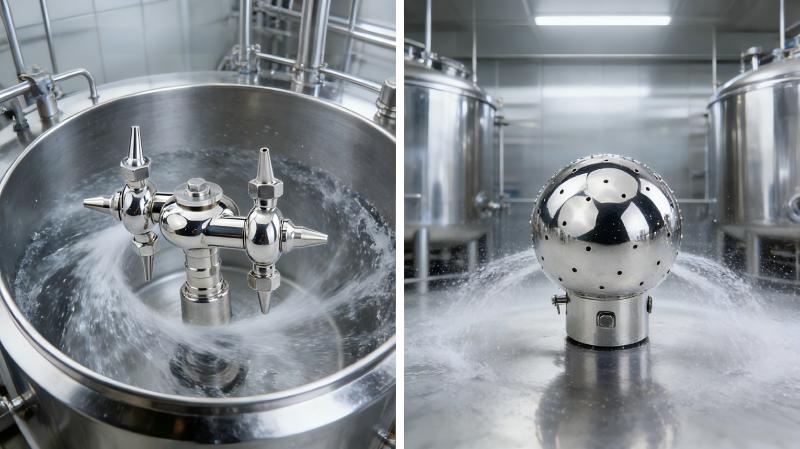
A. What is a Sanitary Static Spray Ball? A sanitary static spray ball, as its name suggests, is a fixed, non-moving sphere with numerous cleverly designed small holes. These holes are arranged at specific angles, so when cleaning fluid (typically water or detergent) is pumped into the spray ball, it sprays out from these holes in fan or jet patterns, covering the tank's inner walls in a 360-degree fashion. Imagine a showerhead, but with a much wider spray range, designed to "shower" the entire interior of a tank with cleaning fluid.
B. Key Features & Advantages (Referencing Sangyie's Products)
-
Simplicity & Cost-Effectiveness: The design of a static spray ball is very simple, with no moving parts. This means a lower initial investment and minimal maintenance costs. It's an attractive option for budget-conscious applications or those requiring a large number of cleaning points.
-
Robust Construction: Sangyie's static spray balls are typically made from high-grade stainless steel (such as SS304 or SS316L). This material offers excellent corrosion resistance, ensuring long-term stable operation in harsh industrial environments, and fully complying with sanitary requirements.
-
Versatility in Spray Patterns: They can provide various spray patterns, including 360° full coverage, 180° up, or 180° down, to suit different tank top and bottom configurations.
-
Easy Installation: Whether with threaded, welded, or clamped connections, Sangyie's static spray balls can be easily integrated into your tanks, offering high flexibility.
-
Low Flow Requirements: For situations with limited water or cleaning agent supply, static spray balls can work effectively at lower flow rates.
C. Limitations While static spray balls offer many benefits, their cleaning power primarily relies on fluid rinsing and dissolving action, lacking significant impact force. This means that for particularly stubborn soils or tanks with complex geometries, their cleaning effectiveness might be limited. Sometimes, achieving thorough cleanliness may require longer cleaning times or the use of more chemicals.
D. Ideal Applications for Sangyie Static Spray Balls
-
Small to Medium-Sized Tanks: Suitable for tanks with smaller volumes and relatively simple internal structures.
-
Cleaning Light, Soluble Soils: For example, cleaning tanks that have stored water, sugar solutions, certain oils, or alcohol—non-viscous products that are easy to rinse.
-
Pre-Rinsing Cycles: Static spray balls can serve as a pre-rinse step before more intensive cleaning, removing most loose dirt.
-
Holding Tanks, Storage Vessels, Blending Tanks: Especially suitable for storage or blending vessels where the product viscosity is not high and is easy to clean.
III. Exploring Sanitary Rotary Cleaners (Rotary Spray Heads)
A. What is a Sanitary Rotary Cleaner? Unlike the fixed static spray ball, a sanitary rotary cleaner (often called a rotary spray head) is a dynamic cleaning device. It uses internal fluid dynamics or gear drives to make the spray head rotate, generating a high-impact, concentrated, and continuously changing spray pattern. You can imagine it as a rotating water gun that doesn't just sprinkle water but uses powerful jets to repeatedly scour every corner of the tank.
B. Key Features & Advantages (Referencing Sangyie's Products)
-
Superior Cleaning Performance: The most significant advantage of rotary cleaners is their powerful mechanical impact force. High-speed rotating jets effectively remove stubborn, sticky, viscous, or baked-on soils from tank walls, providing a more thorough and efficient cleaning effect.
-
Reduced Cleaning Times: Due to their strong cleaning capabilities, rotary cleaners can significantly shorten CIP cycles, thereby increasing production efficiency.
-
Optimized Resource Usage: Although seemingly more "powerful," high impact often means achieving better cleaning results in less time with less water and fewer chemicals, thus saving operational costs.
-
Wide Range of Flow Rates and Pressures: Sangyie's rotary cleaners are adaptable to various tank sizes and different cleaning intensity requirements.
-
Self-Cleaning Design: Many Sangyie rotary cleaners feature self-draining and self-cleaning capabilities to ensure the device itself remains hygienic during the cleaning process.
-
Durable Materials: Also constructed from sanitary stainless steel (e.g., SS304, SS316L), ensuring the equipment's robustness, longevity, and compliance with all hygiene standards.
-
Versatile Connectivity: Available with welded, clamped, or threaded connections for easy integration into existing systems.
C. Limitations Rotary cleaners typically have a higher initial investment than static spray balls. Due to their moving parts, while Sangyie designs for reliability, they may theoretically require more specialized maintenance than static spray balls. Additionally, optimal performance might require higher flow rates and pressures.
D. Ideal Applications for Sangyie Rotary Cleaners
-
Large Tanks, Vessels, and Reactors: For large-volume containers with complex internal structures, rotary cleaners provide better coverage and stronger cleaning power.
-
Cleaning Stubborn, Sticky, or Dried-On Soils: For example, cleaning tanks that have stored dairy products, chocolate, yeast, resins, or high-viscosity products.
-
Industries with High Hygiene Standards: In sectors with extremely strict hygiene requirements, such as pharmaceuticals, biotechnology, brewing, and high-end food processing, rotary cleaners are preferred.
-
Applications Prioritizing Efficiency and Resource Saving: If minimizing water and chemical usage and shortening cycle times are critical, rotary cleaners will be a more cost-effective choice.
IV. Key Factors for Choosing Between Rotary Cleaners and Static Spray Balls
When deciding which cleaning device is best for your application, consider the following key factors:
-
A. Tank Size and Geometry:
-
Small or simple tanks: Static spray balls are often sufficient.
-
Large or complex tanks (with agitators, internal structures): Rotary cleaners provide better coverage and impact.
-
-
B. Type and Tenacity of Soil/Residue:
-
Light, soluble, easily rinsed soils: Static spray balls.
-
Heavy, sticky, viscous, or dried-on soils: Rotary cleaners are essential.
-
-
C. Required Level of Cleanliness/Hygiene Standards:
-
Basic rinsing/moderate hygiene: Static spray balls.
-
Sterile, aseptic, or critical hygiene applications: Rotary cleaners are preferred for their thoroughness.
-
-
D. Water and Chemical Consumption Targets:
-
For optimal resource efficiency, especially with difficult soils, rotary cleaners can often be more effective at saving water and chemicals.
-
-
E. Budget Constraints (Initial Investment vs. Operating Costs):
-
Lower upfront cost: Static spray balls.
-
Higher upfront cost, but potential for long-term savings in water, chemicals, and labor: Rotary cleaners.
-
-
F. CIP Cycle Time Objectives:
-
If faster cleaning cycles are required for throughput, rotary cleaners are generally superior.
-
-
G. Maintenance and Longevity:
-
Simplicity of maintenance: Static spray balls.
-
Durability and reliability: Sangyie engineers both types for long service life, but rotary cleaners have moving parts to consider for maintenance.
-
V. Sangyie's Commitment to Optimal Cleaning Solutions
As a company dedicated to R&D and innovation, Sangyie understands the unique needs for sanitary cleaning across different industries. We offer a comprehensive range of sanitary cleaning equipment, including various models and specifications of static spray balls and rotary cleaners, to meet your diverse industrial requirements.
Sangyie consistently upholds quality and innovation. All our products are manufactured with premium materials and exquisite craftsmanship, ensuring high performance, durability, and compliance. We don't just provide products; we offer expert support and customized services. Sangyie's team of experts can work closely with you to select and customize the perfect cleaning solution for your unique process requirements, tank design, and soil types. Our goal is to help customers optimize their CIP processes, improve efficiency, ensure product safety, and reduce operational costs.
VI. Conclusion: Making an Informed Decision for Your CIP System
In summary, both sanitary static spray balls and sanitary rotary cleaners have their unique advantages and ideal application scenarios. Static spray balls, with their simplicity, cost-effectiveness, and low maintenance, are suitable for light soils and simple tank cleaning. Rotary cleaners, on the other hand, with their powerful mechanical impact, efficiency, and resource optimization capabilities, are the ideal choice for tackling stubborn soils, large complex tanks, and applications demanding high hygiene standards.
There is no "one-size-fits-all" solution. The optimal choice depends on a careful evaluation of your specific application factors. We encourage you not to choose blindly but to thoroughly understand your cleaning needs and partner with a professional manufacturer like Sangyie. By consulting with Sangyie's expert team, you can receive personalized advice and recommendations to find the most suitable sanitary cleaning solution for your production line, thereby enhancing your operational efficiency and hygiene standards. Contact Sangyie today to explore our comprehensive range of sanitary cleaning solutions!
[Click Here to Contact Us / Visit our Website at www.sangyie.com / Email us at [info@sangyie.com]
Sangyie Technology — Engineering the Flow of Your Success.
Holiday Notice: 2026 Chinese New Year Closure
What is a Stainless Steel Sight Glass and How Does It Work
Related Article

DIN 11866 is the overarching standard for aseptic systems that uses DIN 11850 as its "Series A" option.