Mini Diaphragm Valves with VCR Connections – Compact Precision for High-Purity Fluid Control
In high‑purity processing, every component must earn its place. Space is limited, contamination risks are high, and regulatory demands are non‑negotiable. Whether you’re building a semiconductor wet bench, a sterile filling line, or a bioprocessing skid, your valve choice directly impacts system reliability, product quality, and total cost of ownership.
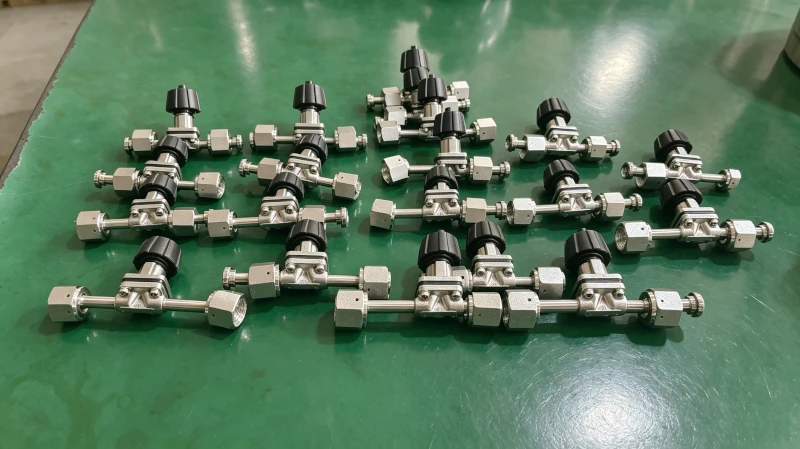
Our new Mini‑Type Diaphragm Valve with VCR Inlet/Outlet delivers the performance of a full‑sized hygienic valve in a fraction of the footprint – engineered specifically for applications where purity, leak‑tightness, and space efficiency are equally critical.
Three Core Advantages
1. True Compactness Without Compromise
The valve body is radically reduced in size, making it ideal for dense manifold assemblies and compact process skids. You save up to 30% of installation space compared to conventional designs, yet flow characteristics remain fully adequate for small‑bore lines (typically ¼” to ½”). This miniaturisation helps you design smaller, lighter systems – lowering material costs and simplifying maintenance access.
2. VCR Connections – The Leak‑Tight Standard
VCR (Vacuum Coupling Retainer) fittings use a metal‑to‑metal face seal with a retainer nut, delivering helium leak rates ≤ 1×10⁻⁹ mbar·L/s. This outperforms most elastomer‑sealed connections, especially under thermal cycling, vibration, and high‑vacuum conditions. The VCR design also withstands hundreds of remakes without seal degradation, reducing spare parts inventory and unscheduled downtime. It is compatible with aggressive chemicals, ultrapure water, and high‑purity gases – making it the go‑to choice for semiconductor and pharmaceutical utilities.
3. Hygienic Design – Zero Dead Leg, Mirror Finish
The weir‑type diaphragm hermetically isolates the actuator from the process media, eliminating any dead leg where product could stagnate or bacteria could proliferate. All wetted surfaces are manufactured from 316L stainless steel with a standard internal roughness Ra ≤ 0.25 μm (electropolishing optional). This ensures:
-
Efficient CIP/SIP cleaning with no residue hold‑up
-
Minimal particle shedding and adsorption
-
Full compliance with FDA and USP Class VI requirements for food and biopharma contact
Diaphragm options include PTFE, EPDM, and compounded elastomers, selected to match your specific media and temperature range.
Versatile Applications Across Industries
While the valve is compact, its application range is anything but small:
-
Semiconductor – chemical delivery, CMP slurry, photoresist, and UPW systems where metallic contamination must be avoided (VIM‑VAR grade 316L available).
-
Biopharma – sterile sampling, buffer preparation, and bioreactor harvest lines where aseptic integrity is paramount.
-
Food & Beverage – dairy, brewing, and beverage filling, where hygienic design and easy cleanability reduce batch changeover time.
-
Personal Care & Cosmetics – emulsion transfer and filling, where smooth surfaces prevent ingredient separation.
-
Fine Chemicals – handling aggressive solvents and high‑temperature media with full chemical compatibility.
Quality and Customisation – Built for Your Process
Every valve is manufactured under strict quality control, with full material traceability and test certificates upon request. We comply with ASME BPE, SEMI F20, and EHEDG guidelines, ensuring your validation and audit requirements are met without extra hassle.
Customisation is not an afterthought – it’s a standard offering. Choose from:
-
Manual or pneumatic actuation (NO, NC, or double‑acting)
-
Various connection styles (VCR, weld ends, tube extensions)
-
Special surface finishes and electropolishing
-
Diaphragm materials tailored to your process chemistry
Our engineering team works directly with you to develop bespoke configurations, including multi‑valve manifolds and custom port arrangements.
Why This Valve Matters for Your Bottom Line
Reliability in high‑purity processes translates directly to yield, uptime, and regulatory peace of mind. A single leak or contamination event can cost thousands in lost product and investigation time. By choosing a valve that combines miniature footprint with VCR sealing and hygienic design, you are investing in:
-
Reduced installation and piping costs
-
Lower maintenance frequency and spare part consumption
-
Consistent product quality batch after batch
-
Faster, more effective cleaning cycles
Get the Technical Details
We invite you to evaluate our Mini Diaphragm Valve for your next project. Datasheets, 3D models, and application notes are available on request. For special sizes or custom machining, simply reach out to our technical sales team – we respond within 24 hours.
Contact us today to discuss your specific requirements, or visit our product page to download the full specification package.
[Click Here to Contact Us / Visit our Website at www.sangyie.com / Email us at [info@sangyie.com]
Sangyie Technology — Engineering the Flow of Your Success.
DIN 11850 vs. DIN 11866
Hygienic Sandwich vs Standard Butterfly Valve: Key Differences
Related Article

DIN 11866 is the overarching standard for aseptic systems that uses DIN 11850 as its "Series A" option.