How to Choose the Right Butterfly Valve for Efficient Fluid On/Off Control
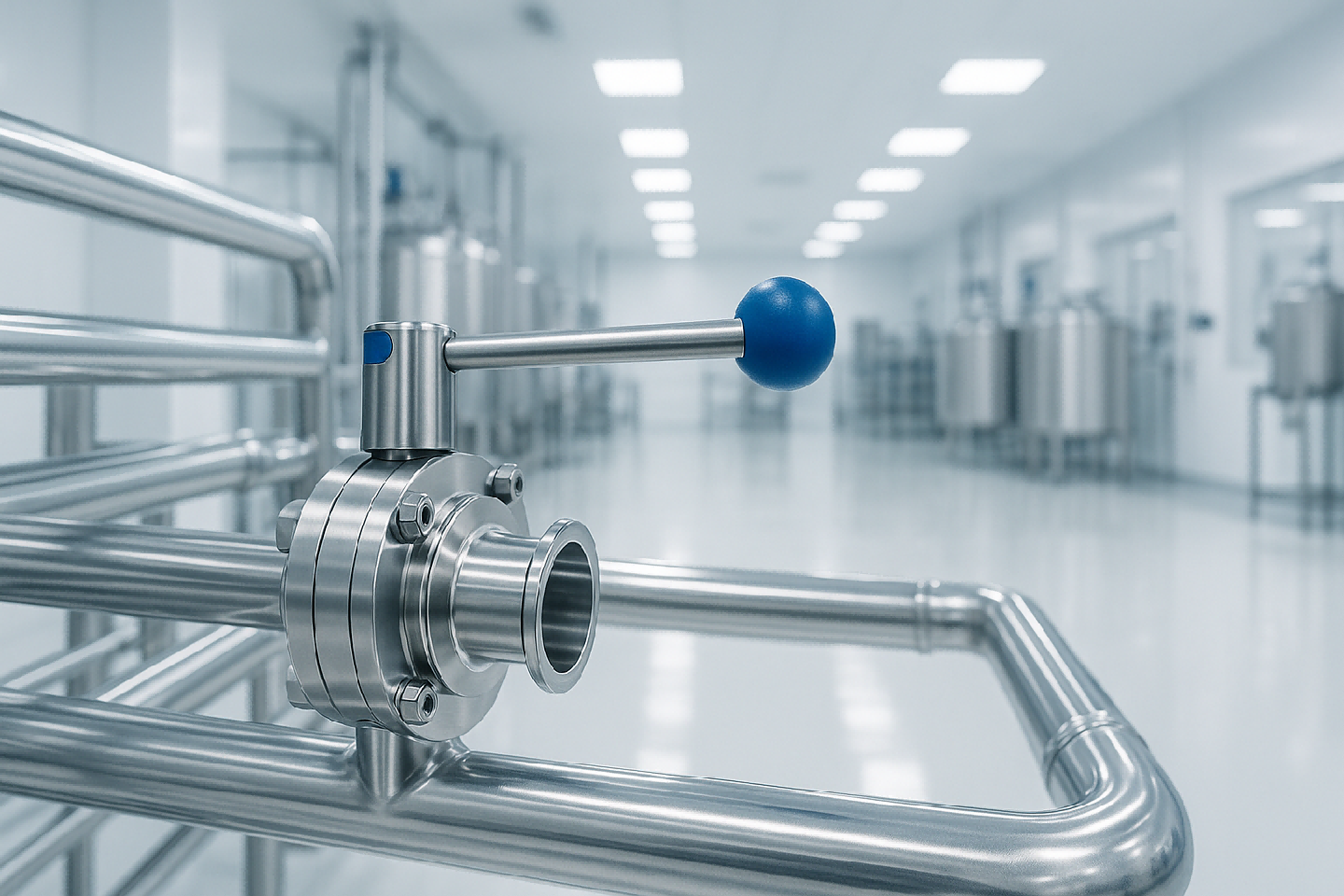
However, the selection of this seemingly simple valve is more complex than it appears. An unsuitable butterfly valve can lead to leaks, product contamination, cleaning difficulties, and even costly downtime for an entire production line.
So, how can you select the ideal butterfly valve for your specific application to achieve truly efficient and secure fluid control? Here are five critical factors you must consider.
1. Material Selection: The Foundation of Safety and Durability
For high-purity applications, the materials of a valve's wetted parts (body and disc) and its seals are of paramount importance.
-
Valve Body & Disc Materials:
-
Stainless Steel 304 (SS304): Suitable for general-purpose fluids like water and some beverages, offering good corrosion resistance.
-
Stainless Steel 316L (SS316L): The premier choice for high-purity applications. With the addition of molybdenum, its resistance to chloride corrosion (from cleaning agents, saline solutions, etc.) and acidic/alkaline media is far superior to SS304. For industries with the highest standards, such as dairy, pharmaceuticals, and bioprocessing, SS316L is the mandatory standard.
-
-
Seal Materials:
-
EPDM (Ethylene Propylene Diene Monomer): Offers good temperature resistance (approx. -30°C to 130°C) and is resistant to acids, alkalis, and oxidizing chemicals. It's a versatile choice for water-based fluids and steam applications.
-
Silicone: Features excellent high and low-temperature resistance (approx. -50°C to 180°C). It is non-toxic and odorless, making it common in food and pharmaceutical industries.
-
Viton® (FKM): Provides superior resistance to oils and chemicals, ideal for media containing fats, oils, or aggressive chemicals.
-
PTFE (Polytetrafluoroethylene): Resistant to nearly all chemicals and has a very low coefficient of friction. However, it is less flexible and is often used in composite form with other materials.
-
Selection Advice: Always determine the optimal material combination based on your fluid media's characteristics, operating temperature, and your CIP/SIP (Cleaning-In-Place / Sterilization-In-Place) protocols.
2. Connection Type: The Key to Installation and Maintenance
The connection type dictates the ease of installation, sealing reliability, and long-term maintenance costs.
-
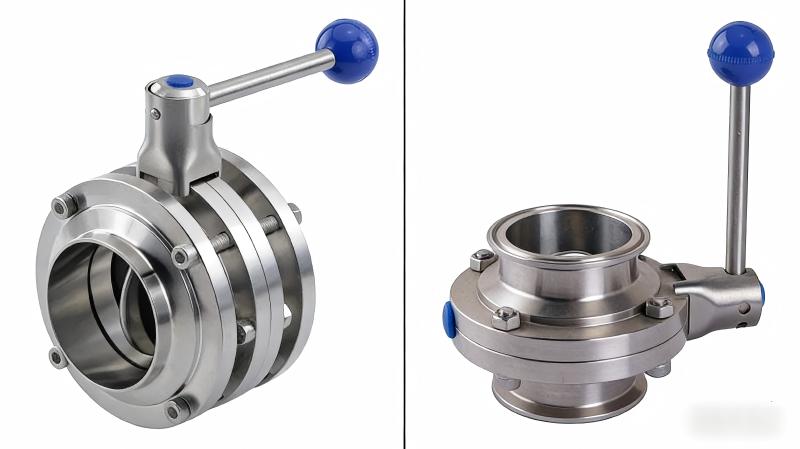
Clamp (Tri-Clamp): This is the most prevalent connection type in sanitary piping systems. It allows for extremely easy assembly and disassembly without special tools, facilitating routine cleaning and inspection while minimizing hygienic dead legs.
-
Weld: Provides a permanent, seamless connection with a perfectly smooth internal transition, making it the top choice for the most critical hygienic applications. The downside is that it cannot be disassembled, making maintenance or replacement more complex.
-
Threaded / Flange: Common in some industrial applications but rarely used in high-purity industries. The crevices in threads can trap product and bacteria, creating sanitary dead legs that are difficult to clean thoroughly.
Selection Advice: For pipelines requiring frequent disassembly for cleaning, the clamp connection is highly recommended. For permanent installations with supreme hygienic requirements, consider weld connections.
3. Actuation Method: Balancing Manual and Automated Control
Butterfly valves can be operated manually or automated with an actuator.
-
Manual Actuation: Operated via a handle, this option is simple and low-cost. Multi-position handles allow the valve to be locked in several preset positions for basic flow regulation. It is suitable for applications that are operated infrequently and do not require remote control.
-
Pneumatic Actuation: Uses compressed air for fast, reliable, and powerful actuation, easily enabling remote automated control. It is available in single-acting (spring return) and double-acting (air-to-open, air-to-close) configurations and can be integrated with solenoid valves and sensors into a PLC control system.
-
Electric Actuation: Driven by a motor, this method allows for precise positioning and flow modulation. However, it is generally slower and more expensive than pneumatic actuation.
Selection Advice: For simple on/off tasks or manual lines, choose manual actuation. For automated production lines, pneumatic actuators offer the best balance of efficiency and cost-effectiveness.
4. Structural Design: The Guarantee of Cleanliness and Efficiency
The design details of a high-quality sanitary butterfly valve should not be overlooked.
-
Surface Finish: Wetted surfaces must be finely polished to a low Ra (surface roughness) value, typically below 0.8μm and sometimes as low as 0.4μm, to prevent bacterial adhesion and ensure thorough cleaning.
-
Crevice-Free Design: The internal cavity of the valve should be smooth and free of any grooves or dead legs where product can be trapped, ensuring complete drainability and compliance with CIP/SIP requirements.
-
Body Strength: A superior valve body is made using precision casting or forging processes to ensure sufficient mechanical strength and pressure resistance, preventing deformation under high pressure or water hammer effects.
5. Certifications and Standards: Your Passport to Quality and Compliance
For companies exporting products or serving high-end markets, compliance with international standards is a crucial measure of quality. Certifications such as 3-A, EHEDG, and FDA signify that a product meets globally recognized, stringent standards for hygienic design, material safety, and cleanability.
Sangyie: Your Trusted Partner in Fluid Control
Choosing the right butterfly valve is a systematic process that directly impacts your production efficiency, product safety, and operational costs.
As a leading manufacturer specializing in high-purity valves, valve control technology, high-purity pumps, high-shear mixers, and sanitary tube fittings, Sangyie has extensive experience serving the food processing, beverage, brewing, wine, dairy, cosmetic, pharmaceutical, and biotechnology industries. We understand that the right valve is more than just a component—it's a critical asset that ensures your production line runs stably, efficiently, and safely.
Driven by R&D and innovation, all our products are crafted from premium raw materials (such as SS316L) and seals from top international brands, strictly adhering to the highest sanitary design standards. Whether you need a clamp butterfly valve for quick takedown or an intelligent pneumatic butterfly valve for your automated line, we provide:
-
A Comprehensive Product Line: Meeting all your needs from manual to fully automated, and from simple on/off to precise flow control.
-
Expert Technical Consultation: Our team of specialists will help you design the optimal valve solution tailored to your specific operating conditions (media, temperature, pressure, and control requirements).
-
Reliable Quality Assurance: Our products meet or exceed major international sanitary standards, giving you complete confidence and peace of mind.
If you are navigating the complexities of valve selection or looking to optimize your current fluid handling system, we invite you to contact us. Let our expertise and quality help you achieve efficient and safe fluid control, safeguarding the excellence of your products.
The "Invisible Guardians" of Hygiene: Understanding the 3A Standard in Valves, Pumps, and Fittings
The Invisible Line of Defense: How ASME BPE-2024 Safeguards Every Drop of Medicinal Fluid
Related Article

DIN 11866 is the overarching standard for aseptic systems that uses DIN 11850 as its "Series A" option.