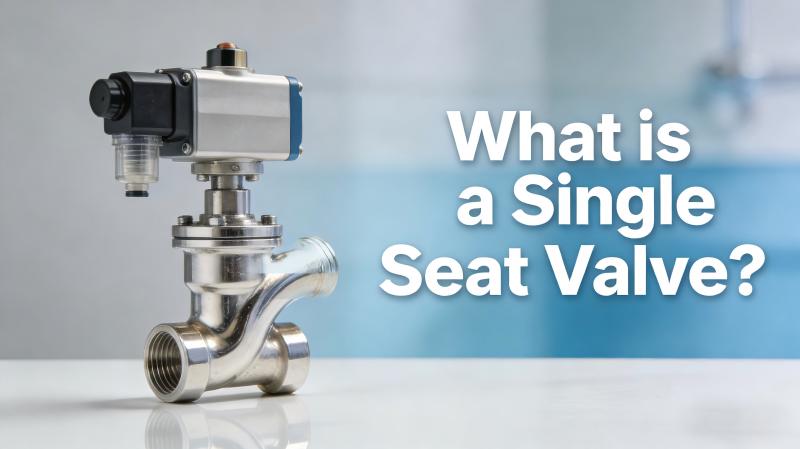
What is a Single Seat Valve? Hygienic Flow Control Explained
In the complex world of sanitary processing—whether you are brewing beer, processing milk, or manufacturing injectable drugs—controlling the flow of liquids is a daily challenge. You need a solution that is reliable, easy to clean, and cost-effective.
Enter the Sanitary Single Seat Valve.
Often considered the "workhorse" of the hygienic industry, these valves are found in almost every food and pharmaceutical plant globally. But what exactly is a single seat valve, and why is it so critical for your process line?
As a leading sanitary valve manufacturer, Sangyie is here to break down the engineering behind this essential component.
Defining the Single Seat Valve
A single seat valve is a pneumatically or manually operated valve used to shut off or change the direction of fluid flow.
As the name implies, it features one single contact point (seat) between the moving plug and the valve body to stop the flow. This simple yet robust design makes it the go-to choice for applications where strict separation between two different fluids is not required at the same time.
How Does It Work?
The operation of a Sangyie single seat valve is straightforward, which is the key to its reliability:
-
The Actuator: Compressed air is supplied to a pneumatic actuator at the top.
-
The Movement: This air pressure pushes a shaft (stem) down or pulls it up.
-
The Seal: The plug at the end of the shaft presses against the valve seat (closing the valve) or lifts away from it (opening the valve).
Most single seat valves are Normally Closed (NC), meaning a spring keeps the valve closed, and air is needed to open it. This is a safety feature: if the air supply fails, the valve automatically closes to stop the flow.
Key Features of Sangyie Single Seat Valves
Not all valves are created equal. To meet the high standards of the semiconductor, biotech, and food industries, our valves are engineered with the following specifications:
1. Hygienic Design (3-A & FDA Compliant)
We construct our valve bodies from high-grade AISI 316L Stainless Steel. The internal surfaces are polished to a Ra < 0.8μm finish. This ensures there are no crevices for bacteria to hide, making the valve fully capable of CIP (Clean-in-Place) and SIP (Sterilization-in-Place).
2. Durability and Maintenance
With fewer moving parts than complex mixproof valves, single seat valves are incredibly durable. Sangyie utilizes heavy-duty gaskets (EPDM, FKM, or PTFE) that withstand high temperatures and aggressive cleaning chemicals.
3. Versatility
They can be configured as:
-
Shut-off valves: Simple Open/Close function (2 ports).
-
Divert valves: Redirecting flow from one pipe to another (3 to 5 ports).
Single Seat vs. Double Seat (Mixproof): What’s the Difference?
This is the most common question we receive from engineers.
-
Single Seat Valve: Has one seal. If the seal fails, liquid could leak to the other side. Therefore, you should NOT use it to separate two different fluids (e.g., raw milk and cleaning chemicals) simultaneously. It is best used for simple shut-off or when the line is dedicated to one product at a time.
-
Double Seat (Mixproof) Valve: Has two independent seals creating a leakage chamber in between. It allows you to run product in one pipe and CIP fluid in the other safely.
The Verdict: If you need cost-effective, reliable flow control for non-simultaneous processing, the Single Seat Valve is the superior, economical choice.
Applications Across Industries
Due to their reliability, Sangyie single seat valves are widely used in:
-
Dairy & Beverage: Regulating flow in pasteurization loops and filling machines.
-
Brewing: Managing wort transfer and fermentation tank routing.
-
Personal Care & Cosmetics: Handling viscous creams and shampoos (often paired with our Sanitary Pumps).
-
Biotech & Pharma: Controlling Water for Injection (WFI) loops where sterility is paramount.
Why Choose Sangyie?
At Sangyie, we don't just supply parts; we engineer solutions. As a manufacturer specializing in sanitary valves, pumps, and high-shear mixers, we understand how a valve interacts with the rest of your system.
-
Traceability: Full material certification for all 316L components.
-
Customization: We offer various body configurations (L-type, T-type) and control tops to integrate with your PLC system.
-
Global Standard: Our valves are compatible with standard sanitary tubing and fittings, ensuring easy installation.
Conclusion
The single seat valve is a fundamental component of any hygienic processing line. Its simplicity is its strength, offering safe and effective flow control for the majority of sanitary applications.
Need help selecting the right valve configuration? Trust the experts at Sangyie. Contact our engineering team today to discuss your specific requirements or to request a catalog of our premium sanitary valves and fittings.
[Click Here to Contact Us / Visit our Website at www.sangyie.com / Email us at [info@sangyie.com]
Sangyie Technology — Engineering the Flow of Your Success.
What is a Sanitary Check Valve? The Guardian of Flow Direction
What is a Sanitary Pump? Engineering Hygienic Excellence
Related Article

DIN 11866 is the overarching standard for aseptic systems that uses DIN 11850 as its "Series A" option.