What is a Sanitary Check Valve? The Guardian of Flow Direction
In any fluid processing system—whether for dairy, beverages, or pharmaceuticals—controlling where the fluid goes is important. But controlling where it doesn't go is equally critical.
Imagine your expensive sanitary pump stops running, and gravity forces the fluid in the vertical pipe to rush backward. This "backflow" can cause water hammer, damage pump impellers, or contaminate upstream processes.
The solution is simple but vital: The Sanitary Check Valve.
As a specialized sanitary valve and pump manufacturer, Sangyie engineers these components to ensure your production line flows in only one direction: Forward.
Defining the Sanitary Check Valve
A sanitary check valve (also known as a non-return valve) is a self-acting valve that allows fluid to flow in one direction while automatically preventing reverse flow.
Unlike other valves that require a handle or pneumatic actuator to operate, a check valve works entirely based on the pressure of the fluid itself. It is the "traffic cop" of your piping system, ensuring one-way traffic without manual intervention.
How Does It Work?
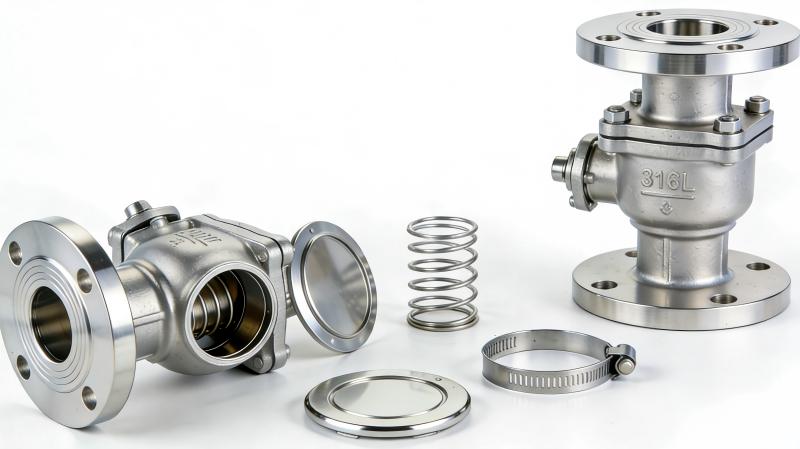
The mechanism is elegant in its simplicity. Most sanitary check valves utilize a Spring-Loaded design:
-
Opening (Forward Flow): When the pressure of the fluid flowing forward exceeds the "cracking pressure" (the force of the internal spring), it pushes the valve disc open, allowing liquid to pass.
-
Closing (Reverse Flow): When the flow stops or back pressure occurs, the spring (assisted by the back pressure) immediately pushes the disc back against the seat, creating a tight seal.
What Makes It "Sanitary"?
You might ask, "Can I just use a standard industrial check valve?" In food and pharma industries, the answer is no.
Standard valves have threads, pockets, and rough surfaces where bacteria can grow. Sangyie’s Sanitary Check Valves are engineered for hygiene:
-
Material: Constructed from AISI 316L Stainless Steel for maximum corrosion resistance.
-
Surface Finish: Polished to Ra < 0.8μm, ensuring no product residue sticks to the valve.
-
Crevice-Free: Designed to be easily disassembled or cleaned via CIP (Clean-in-Place) without trapping particles.
-
Food-Grade Seals: We use FDA-compliant EPDM, FKM, or PTFE gaskets.
Why are Sanitary Check Valves Critical?
These valves are not just accessories; they are system protectors.
1. Protecting Your Pumps
This is the #1 use case. If a pump stops and fluid rushes back, it can spin the impeller in reverse. If the pump restarts during this reverse spin, the shaft can snap. A Sangyie check valve installed on the discharge side prevents this.
2. Preventing Water Hammer
Sudden backflow can cause pressure surges (water hammer) that rupture pipes or damage sanitary fittings. The check valve dampens this effect.
3. Avoiding Cross-Contamination
In systems with multiple product lines, check valves ensure that Product A does not accidentally flow back into the tank of Product B.
Applications
-
Vertical Pipe Runs: To prevent liquid from draining back down when the system is off.
-
CIP Systems: Ensuring cleaning chemicals flow to the target area and don't contaminate water supplies.
-
High-Purity Water (WFI): Maintaining unidirectional flow in pharmaceutical loops.
Why Choose Sangyie?
At Sangyie, we understand that a check valve is small, but its failure can be costly.
-
Integrated Solutions: Our check valves are sized perfectly to match our Sanitary Pumps and Sanitary Tubes, ensuring no flow restriction.
-
Quality Assurance: Every valve undergoes pressure testing to ensure a 100% leak-proof seal.
-
Variety: We offer Clamp, Weld, and Threaded connections to fit your existing setup.
Conclusion
The sanitary check valve is the silent hero of the processing line. It protects your equipment, ensures process safety, and requires no external power to operate.
Protect your pumps and process today. Explore Sangyie’s range of high-quality sanitary valves and fittings. As a dedicated manufacturer, we deliver the reliability your business demands.
[Click Here to Contact Us / Visit our Website at www.sangyie.com / Email us at [info@sangyie.com]
Sangyie Technology — Engineering the Flow of Your Success.
What is a Sanitary Ball Valve and How Does It Work?
What is a Single Seat Valve? Hygienic Flow Control Explained
Related Article

DIN 11866 is the overarching standard for aseptic systems that uses DIN 11850 as its "Series A" option.