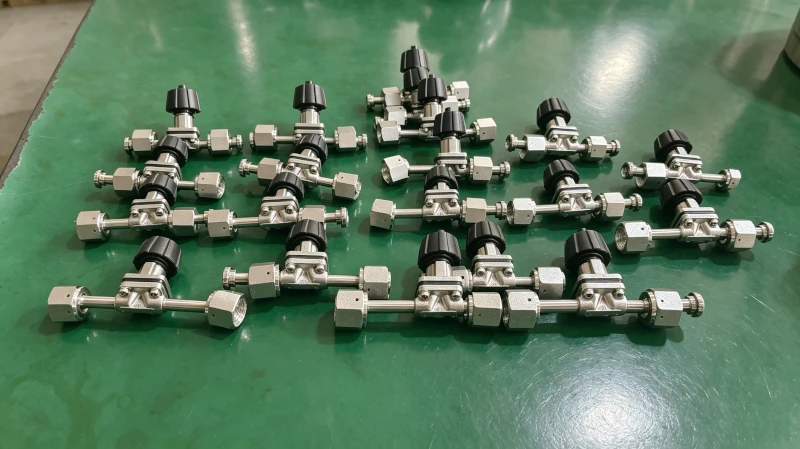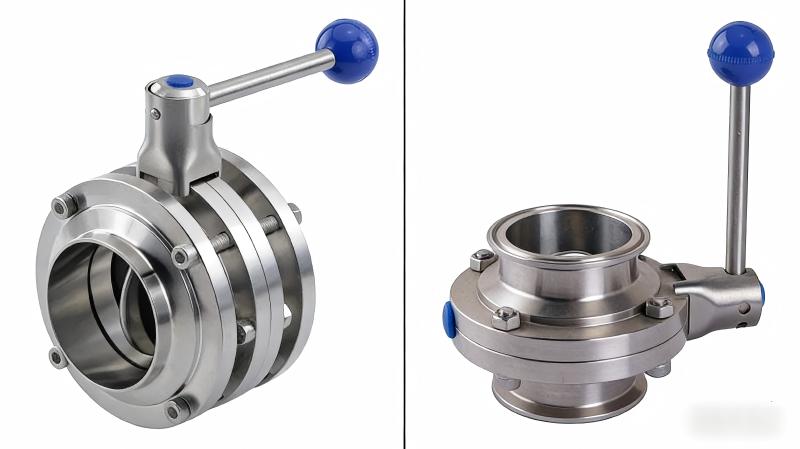
What are Sanitary Fittings? The Essential Guide for Hygienic Processing
In industries where purity and hygiene are non-negotiable—such as food processing, pharmaceuticals, and semiconductor manufacturing—the components used in piping systems play a critical role. One of the most vital components in these systems is the sanitary fitting.
If you are an industrial hardware purchaser or a process engineer, understanding the nuances of sanitary fittings (also known as hygienic fittings) is crucial for ensuring product safety, regulatory compliance, and system efficiency.
Defining Sanitary Fittings: More Than Just Pipe Connectors
So, what are sanitary fittings exactly?
Unlike standard industrial pipe fittings used in oil or general plumbing, sanitary fittings are engineered components designed specifically to prevent the entrapment of bacteria and contaminants. They are used to join sections of piping, valves, pumps, and high-shear mixers in systems where cleanliness is paramount.
The defining characteristic of a sanitary fitting is its ability to be cleaned—either manually or via Clean-in-Place (CIP) processes. To be classified as "sanitary," the fitting must not have any crevices, pockets, or sharp threads where product residue can accumulate and bacteria can grow.
Key Features of High-Quality Sanitary Fittings
To meet the rigorous demands of industries like biotech and brewing, sanitary fittings must possess specific characteristics:
-
Material Integrity: They are almost exclusively manufactured from 304 or 316L Stainless Steel. 316L is preferred for pharmaceutical and acidic food applications due to its superior corrosion resistance.
-
Surface Finish (Ra): The internal surface must be incredibly smooth. Roughness Average (Ra) is the measure used here. Sanitary fittings typically require a low Ra value (e.g., polished to 32Ra or better) to minimize particle adhesion.
-
Cleanability: They utilize specialized gaskets and clamp designs (like Tri-Clamp) that create a flush seal, eliminating "dead legs" in the flow path.
Common Types of Sanitary Fittings
Depending on your specific application—whether it's a dairy line or a high-purity semiconductor water system—you will encounter different connection types:
1. Butt-Weld Fittings
Used for permanent connections. These are welded directly to the tube ends using orbital welding to ensure a seamless, crevice-free bond. They are ideal for long transmission lines where disassembly is rarely required.
2. Tri-Clamp (Tri-Clover) Fittings
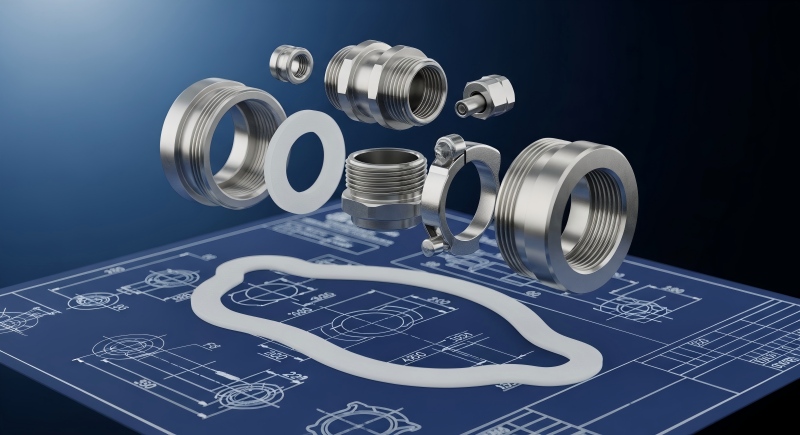
The most popular type in the food, beverage, and pharmaceutical industries. A Tri-Clamp connection consists of two ferrules, a gasket, and a clamp.
-
Pros: Easy to assemble and disassemble for cleaning or inspection without tools.
-
Applications: Connecting pumps, valves, and tank accessories.
3. Bevel Seat Fittings (Acme Thread)
Often found in older food and dairy processing plants. They use a threaded union nut and a gasket. While robust, they are slightly less hygienic than Tri-Clamps due to the threads, though still widely used in specific heavy-duty flow environments.
4. I-Line and Q-Line Fittings
Designed for higher pressure and vibration applications, offering a more robust interlocking design while maintaining sanitary standards.
Understanding Standards: 3A, DIN, and ASME BPE
When sourcing sanitary fittings, you will see various certifications. These ensure the hardware meets international safety rules:
-
3A Sanitary Standards: The gold standard for the US dairy and food industry. It ensures the design allows for proper cleaning.
-
ASME BPE (BioProcessing Equipment): The strictest standard, primarily for the biopharmaceutical and personal care industries. It dictates precise dimensions, surface finishes (often electropolished), and material traceability.
-
DIN / ISO: Common European standards often used in brewing and beverage equipment globally.
Industries That Rely on Sanitary Fittings
As a manufacturer, we supply these critical components to a wide range of sectors:
-
Food & Beverage: From tomato sauce transfer lines to soft drink bottling.
-
Dairy: Milk, cheese, and yogurt processing requires strict 3A compliance.
-
Brewing & Distilling: Yeast propagation and wort transfer lines.
-
Pharmaceutical & Biotech: Manufacturing vaccines and medicines requires ASME BPE fittings to prevent cross-contamination.
-
Personal Care & Cosmetics: Lotions and shampoos are viscous and require smooth flow paths.
-
Semiconductor: High-purity water systems for chip manufacturing require ultra-high purity stainless steel fittings (often electropolished).
Why Choose Sangyie for Your Sanitary Flow Components?
Sourcing the right sanitary fittings is about more than just dimensions; it's about trust and quality assurance. At Sangyie , we specialize in manufacturing high-precision sanitary valves, pumps, and pipe fittings.
Whether you need a custom manifold for a high-shear mixer or bulk standard Tri-Clamp fittings for a new brewery setup, our products undergo rigorous testing to meet global standards (3A, DIN, SMS, ASME BPE).
[Click Here to Contact Us / Visit our Website at www.sangyie.com / Email us at [info@sangyie.com]
Sangyie Technology — Engineering the Flow of Your Success.
DIN 11866 vs. ASME BPE: Key Differences in Dimensions and Surface Finish
Standard comparison of 316L stainless steel: EN1.4404 vs EN1.4435
Related Article

DIN 11866 is the overarching standard for aseptic systems that uses DIN 11850 as its "Series A" option.