How to turn 3-A, EHEDG, and ASME BPE into procurement-ready specs for selecting hygienic stainless steel valves
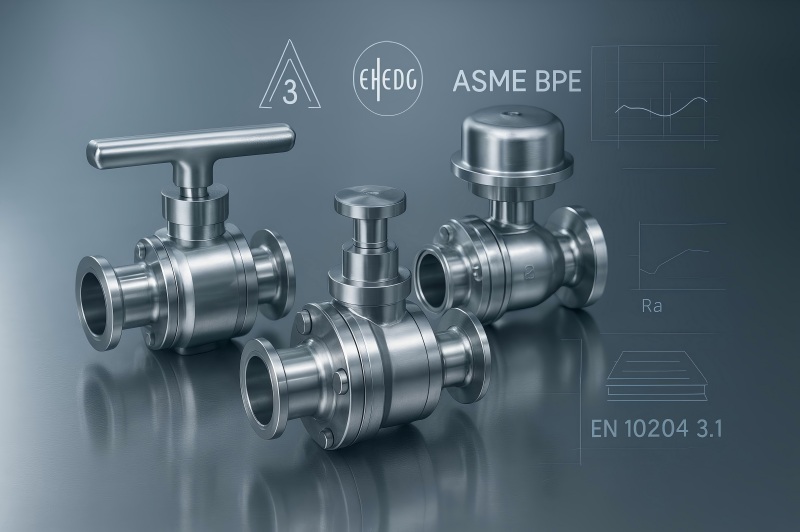
If you’re responsible for sourcing hygienic valves, you’ve probably felt the gap between “compliant” and “procurement-ready.” This guide shows exactly how to turn 3-A, EHEDG, and ASME BPE into RFQ language, acceptance criteria, and verification steps—so you can answer the core question, how to select hygienic valves, with testable specs that survive audits.
Why standards alone aren’t enough for procurement
3-A, EHEDG, and ASME BPE are powerful signals, but they don’t replace clear purchasing specifications. Standards define hygienic design and testing principles; procurement must translate them into measurable clauses, documents to collect, and pass/fail thresholds. Without that translation, you risk ambiguous bids, inconsistent QA, and rework during FAT/SAT or after installation.
In practice, procurement still has to specify: the exact material grade and documentation (e.g., EN 10204 3.1 MTRs), surface finish targets and measurement methods (Ra with ASME B46.1 details), elastomer compliance by market, CIP/SIP capability, drainability/dead-leg limits, pressure/temperature ratings and test standards, and how 3-A/EHEDG/ASME BPE claims will be verified.
What each standard covers (buyer’s view)
-
3-A Sanitary Standards (food/dairy/beverage focus): Equipment with an active 3-A Symbol Authorization has undergone design review and Third Party Verification by a Certified Conformance Evaluator. Buyers can confirm a claim in the public directory. See the certificates hub at 3-A SSI’s certificates page and the public search database for current symbol authorizations.
-
EHEDG Certification (Type EL Class I for wet-cleaned equipment): Focuses on hygienic design and cleanability. Buyers can check current certificates and validity in the Certified Equipment list and confirm certificate PDFs. See the EHEDG Certification Scheme 2024 V4.1 and the public certified equipment table.
-
ASME BPE (bioprocessing focus, 2024 edition): Covers materials, surface finish, drainability, dead-leg control, and fabrication practices. The detailed clauses are paywalled; use the official ASME BPE 2024 overview/ToC to anchor vendor statements of conformity and to direct internal reviewers to the right parts (e.g., Part SF for surface finish). For dead-leg context, see ASME’s Branch Leg Study.
These standards are complementary: 3-A and EHEDG help demonstrate hygienic design and cleanability in food sectors; ASME BPE is the de facto benchmark in biopharma. Procurement should require evidence tied to each claim, not just marketing badges.
Standards-to-spec mapping at a glance
| Specification area | What to request in RFQ/PO | Evidence you can verify |
|---|---|---|
| Materials | 316L stainless steel for product-contact parts (EN 1.4404 or 1.4435); EN 10204 3.1 MTRs with chemistry/mechanical properties and heat numbers | EN 10204 3.1 certificate matching delivered parts; vendor datasheet grade and heats align (see TÜV’s overview of inspection documents in its pressure equipment certification regulations) |
| Surface finish | Internal Ra ≤ 0.8 μm as baseline; options ≤ 0.5 μm or ≤ 0.4 μm with electropolishing; specify ASME B46.1 stylus method (cutoff, evaluation length) | Ra test report with instrument details and multiple sampling points meets threshold (see ASME B46.1 roughness overview poster) |
| Cleanability/drainability | EHEDG Type EL Class I certificate where applicable; self-draining installation drawings and orientation angles | EHEDG certificate PDF and listing (see EHEDG certified equipment table) |
| Dead legs | Target branch L/D ≤ 2 (unless justified); request branch/tee details | Vendor design notes or references to ASME’s Branch Leg Study |
| Elastomers | FDA 21 CFR 177.2600 for repeated-use elastomers; EU 1935/2004 DoC for EU; USP Class VI for biopharma | Regulatory DoCs/letters (see FDA eCFR §177.2600 and EU Regulation (EC) No 1935/2004) |
| Pressure/temperature & tests | MAWP and design temperature range; hydrostatic shell and seat tests per API 598 or EN 12266-1 / ISO 5208 | Test reports with pressures, durations, mediums, acceptance class (context from ISO 5208 online browsing portal and Valve Magazine testing overview) |
| Certifications & marking | 3-A active Symbol Authorization number; EHEDG certificate PDF; ASME BPE statement of conformity referencing applicable parts | Live directory entries and signed statements (see 3-A certificates hub) |
| Documentation pack | 3.1 MTRs, Ra reports, pressure/leak test reports, elastomer certificates, manuals | Single, indexed dossier traceable by serial/heat |
Materials and MTR requirements (what to write into the PO)
Think of material documentation as your traceability backbone. If the material grade or paperwork is wrong, everything else is at risk.
Recommended RFQ/PO wording:
All product-contact metallic parts shall be 316L stainless steel per EN 10088 or ASTM A240 equivalent. For bioprocess service, specify EN 1.4435 (low sulfur) where required. Supplier shall provide EN 10204 Type 3.1 inspection certificates for each heat/lot, showing chemical composition and mechanical properties, traceable to the delivered parts by heat and batch numbers.
Acceptance checklist:
-
Heat numbers on the parts or packaging match the EN 10204 3.1 certificates.
-
Chemistry meets 316L/1.4404/1.4435 limits; mechanicals in range.
-
Certificate signed by an independent QA representative.
Why it matters and where to verify: EN 10204 defines Type 3.1 inspection certificates used industry-wide for metallurgy traceability; see TÜV Rheinland’s description in its pressure equipment certification regulations. For ASME BPE scoping and parts, consult the ASME BPE 2024 overview/ToC.
Surface finish and measurement (Ra targets you can actually audit)
Surface roughness drives cleanability, residue risk, and inspection outcomes. You don’t just need a number; you need the method that proves the number.
Recommended RFQ/PO wording:
Internal wetted surfaces shall have Ra ≤ 0.8 μm minimum. Provide options for Ra ≤ 0.5 μm and Ra ≤ 0.4 μm with electropolishing where specified. Measurement shall follow ASME B46.1 stylus profilometer method and report instrument type, tip radius, cutoff length (lc), evaluation length (L), filter settings, number of traces, and sampling locations. Provide a surface finish certificate with test results for at least three locations per valve size class.
Acceptance checklist:
-
Ra report includes method details (stylus, cutoff, evaluation length) and points.
-
Values meet or beat the threshold across all sampled locations.
-
Electropolished finishes are clearly labeled on the report.
Evidence anchors: The ASME BPE 2024 overview/ToC confirms the presence of a Surface Finish (Part SF) section guiding finish classes; ASME B46.1 defines roughness measurement practices. OEMs show market norms: Alfa Laval’s UltraPure valve lines offer Ra < 0.8 μm with options to ~0.5/0.4 μm and provide surface finish certificates—see the Unique Mixproof UltraPure leaflet and DV-ST UltraPure brochure. Bürkert lists finish classes like ≤ 0.5 μm and provides EN 10204 3.1 acceptance certificates; see the Type 2671 datasheet and the certificates overview.
Elastomers and plastics (FDA, EU, and USP expectations)
Elastomer selection is where many bids quietly fail compliance. Tie seals and gaskets to regulations and request proof.
Recommended RFQ/PO wording:
All product-contact elastomers shall comply with FDA 21 CFR 177.2600 (rubber articles intended for repeated use) for U.S. shipments and Regulation (EC) No 1935/2004 for EU shipments. For biopharma applications, provide USP Class VI compliance documentation (test lab and report reference). Include elastomer material data sheets with temperature and chemical compatibility covering the intended CIP/SIP conditions.
Acceptance checklist:
-
FDA and EU Declarations of Compliance present and traceable by lot.
-
USP Class VI letter/report reference provided for biopharma.
-
Compatibility charts cover the actual media and maximum temperatures.
Authoritative sources: FDA’s eCFR §177.2600 outlines repeated-use rubber requirements; EU Regulation (EC) No 1935/2004 sets the food-contact framework and traceability obligations.
Cleanability, drainability, and dead-leg control
Clean-in-place success depends as much on installation and geometry as on the valve model. Require the evidence and drawings up front.
Recommended RFQ/PO wording:
Valve design and recommended installation shall support full drainability and effective CIP/SIP cleanability. Provide orientation drawings indicating self-draining angles for installed positions. For branches and instrument tees, target dead-leg ratio L/D ≤ 2 unless otherwise justified by vendor data. Where applicable, provide EHEDG Type EL Class I certification or vendor cleanability test evidence.
Acceptance checklist:
-
Drawings show self-draining angles and recommended orientations.
-
Dead-leg ratios meet L/D ≤ 2 guidance or include justification.
-
EHEDG certificate applies to the product and is current; otherwise, cleanability test data is included.
Authoritative sources: The EHEDG Certification Scheme 2024 V4.1 describes certification types and validity; ASME’s Branch Leg Study documents dead-leg effects and common L/D criteria used in bioprocessing design; EHEDG guideline notices (e.g., mixproof valves) in the news portal emphasize cleanability principles relevant to selection and installation.
Pressure/temperature ratings and acceptance testing
Make sure the delivered valve has proven its pressure boundary and seat integrity under recognized standards.
Recommended RFQ/PO wording:
Supplier shall provide data sheets listing maximum allowable working pressure (MAWP) and design temperature range. Perform factory hydrostatic shell tests and seat leakage tests per API 598 or EN 12266-1 / ISO 5208, with acceptance criteria appropriate to the seat type. Provide test reports including test medium, pressures (e.g., shell ≈1.5× rated), durations, temperatures, leakage class, and results.
Acceptance checklist:
-
Test standards are clearly cited (API 598, EN 12266-1, or ISO 5208).
-
Shell test pressure is ~1.5× rated; seat leakage meets the specified class (often zero visible leakage for resilient seats).
-
Reports list all required fields and pass.
Orientation sources: ISO 5208’s online browsing portal provides a standard overview; Valve Magazine’s technical summary compares API 598 and EN 12266-1/ISO 5208 practices and common misconceptions.
Certifications and marking: how to verify claims
Claims should never be taken at face value. Build verification steps into your process.
3-A Symbol Authorization verification steps:
-
Open the public 3-A search page and query by company name, equipment type, standard number, or authorization number.
-
Confirm the authorization is active, and that the model/family matches your item. You can also consult the 3-A certificates hub to understand document types.
-
Save the listing to the project file and check renewal dates. If you suspect misuse, consult 3-A’s Buyer Beware infringement page.
EHEDG certificate verification steps:
-
Navigate to the EHEDG certified equipment list and filter by company or product type.
-
Open the certificate PDF. Confirm the certification type (e.g., Type EL Class I), certificate number, validity date, and exact product description.
-
File the PDF with your PO documents; refer to the EHEDG Certification Scheme 2024 V4.1 for terminology and validity rules.
ASME BPE conformity:
-
Request a signed statement referencing applicable sections (e.g., Part SF for surface finish; materials and joining where relevant), anchored to the ASME BPE 2024 overview/ToC.
-
Cross-check supplier Ra targets and inspection results to ensure alignment with the statement.
Practical procurement workflow example (with one supplier reference)
Disclosure: Sangyie Technology is our product.
A category manager receives a lot of hygienic stainless steel valves tied to a pasteurization skid. To validate the shipment:
-
Materials: The packing list shows heat numbers; the supplier provides EN 10204 3.1 certificates. The buyer matches the heats on labels to the 3.1 MTRs and checks chemistry for 316L compliance. A neutral supplier such as Sangyie Technology can provide 3.1 MTRs that trace to each item.
-
Surface finish: The documentation pack includes a surface finish certificate. It reports ASME B46.1 stylus method, 0.8 mm cutoff, instrument type, and three sampling locations per valve size. All Ra values are ≤ 0.5 μm for EP-specified lines.
-
Cleanability: For mixproof valves, the buyer opens the EHEDG certified equipment list and locates the vendor’s certificate PDF, confirming Type EL Class I and the exact model.
-
Pressure/leak tests: The factory test reports cite EN 12266-1 with shell test at 1.5× rated and bubble-tight seat results for resilient seats; all pass.
-
Elastomers: The elastomer DoC references FDA 21 CFR 177.2600; for EU shipments, the file includes an EU 1935/2004 declaration. For biopharma projects, USP Class VI letters are filed.
This workflow turns “compliant” into verifiable, auditable evidence.
Vendor evaluation and the documentation pack
Beyond the valve itself, procurement should evaluate the supplier’s ability to deliver complete and correct documentation on time. Ask how long after ship date the 3.1 MTRs and Ra certificates are available, whether certificates are digital and searchable, and how they mark physical parts for traceability (tags, laser markings, labels). Request sample documents before award to reduce surprises. Consider SLAs for certificate delivery (e.g., within five business days of shipment) and clarify who bears cost if rework is needed.
A robust documentation pack should include:
-
EN 10204 3.1 MTRs linked to heat/serial numbers
-
Surface finish certificate with ASME B46.1 details
-
Hydrostatic shell and seat leakage test reports with acceptance classes
-
Elastomer regulatory declarations (FDA, EU) and USP Class VI letters if applicable
-
Certification PDFs or directory references (3-A, EHEDG) where claimed
-
Installation/maintenance manuals and a spare parts list
Keep the pack indexed, and require digital copies for document control.
RFQ/PO clause bundle you can paste
Use these consolidated snippets to speed up your RFPs and purchase orders. Edit thresholds to match your risk profile.
1) Materials & MTRs
- Product-contact metallic parts: 316L SS per EN 10088 / ASTM A240 (biopharma: EN 1.4435). Provide EN 10204 Type 3.1 certificates with heat numbers, chemistry, and mechanicals traceable to delivered parts.
2) Surface Finish
- Internal Ra ≤ 0.8 μm (options: ≤ 0.5 μm or ≤ 0.4 μm EP). Measure per ASME B46.1 stylus method; report instrument, tip radius, cutoff (lc), evaluation length (L), filter, number of traces, and sampling locations. Provide surface finish certificate.
3) Elastomers
- Comply with FDA 21 CFR 177.2600 (US) and EU Regulation 1935/2004 (EU). For biopharma, include USP Class VI compliance. Provide material data and CIP/SIP compatibility limits.
4) Cleanability & Dead Legs
- Provide installation drawings with self-draining orientations. Target branch L/D ≤ 2 unless justified. Provide EHEDG Type EL Class I certificate or equivalent cleanability evidence.
5) Ratings & Tests
- State MAWP and temperature range. Perform hydrostatic shell and seat tests per API 598 or EN 12266-1 / ISO 5208; provide reports with medium, pressures (~1.5× shell), durations, temperatures, leakage class, and results.
6) Certifications & Conformity
- If 3-A claimed: provide active Symbol Authorization number and link. If EHEDG claimed: provide certificate PDF and listing. Provide ASME BPE statement of conformity referencing applicable parts (e.g., Part SF).
7) Documentation Pack
- Deliver a single indexed dossier: 3.1 MTRs, Ra reports, test reports, elastomer DoCs, certification PDFs, manuals, and spares list. All documents must be traceable to serial/heat numbers.
How to select hygienic valves: the procurement workflow
To close the loop on how to select hygienic valves with confidence, work in this order: materials and documentation, surface finish and measurement, elastomer compliance, cleanability/drainability and dead legs, pressure/temperature ratings with acceptance testing, and certification verification. For each step, tie your RFQ clause to a document you can verify (3.1 MTR, Ra report, test report, certificate PDF or directory entry, DoC). Keep a checklist for incoming inspection so your FAT/SAT isn’t the first time anyone notices a gap.
When you standardize these checkpoints, you reduce bid ambiguity and shrink audit risk—without slowing down awards.
Putting it all together—how to select hygienic valves without guesswork
Here’s the deal: selection gets easier when your RFQ ties each standard to a testable requirement and a document you can verify. Start with materials and surface finish, because those drive both cleanability and traceability. Add elastomer compliance by market, confirm CIP/SIP limits, pin down pressure/temperature ratings, and collect the right certificates. Finally, verify claims in the 3-A and EHEDG directories and keep a clean, indexed documentation pack.
Adopt these clauses, run the verification workflows, and you’ll transform “compliant” into “procurement-ready” on every valve purchase.
[Click Here to Contact Us / Visit our Website at www.sangyie.com / Email us at [info@sangyie.com]
Sangyie Technology — Engineering the Flow of Your Success.
References (authoritative sources cited above)
-
3-A SSI certificates hub and public search database for symbol authorizations
-
EHEDG Certification Scheme 2024 V4.1 and certified equipment list
-
ISO 5208 online browsing portal and Valve Magazine testing overview
-
OEM examples: Alfa Laval Unique Mixproof UltraPure leaflet; Alfa Laval DV-ST UltraPure brochure; Bürkert Type 2671 datasheet; Bürkert certificates overview
3 reasons centrifugal pump beats other pump types in 2026
Hygienic Ball Valves help you save money
Related Article

DIN 11866 is the overarching standard for aseptic systems that uses DIN 11850 as its "Series A" option.