Sanitary Union vs. Sanitary Flange: A Comprehensive Guide for Industrial Buyers
In the sanitary process industries—ranging from food and beverage to biopharmaceuticals—the integrity of your piping connections is critical. A poor choice can lead to leaks, bacterial contamination, and costly downtime.
As a leading manufacturer of sanitary valves, pumps, and fittings, Sangyie frequently assists procurement managers and engineers in selecting the right components. The most common debate is: Sanitary Union vs. Sanitary Flange. Which is better for your system?
This guide breaks down the technical differences, pros and cons, and industry standards to help you make an informed decision.
1. What is a Sanitary Union?
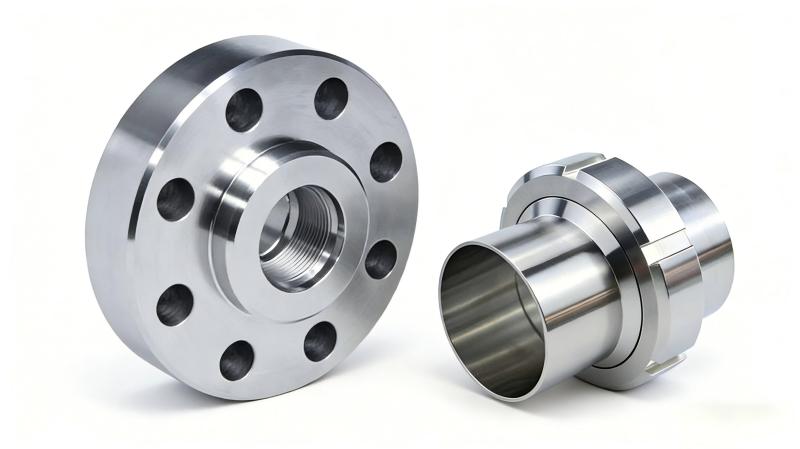
A Sanitary Union (often called a screwed connection) is a heavy-duty, threaded coupling system designed to join pipes or equipment securely. Unlike standard plumbing unions, sanitary versions are engineered with high precision to minimize internal crevices where bacteria could hide.
Key Characteristics:
-
Design: Consists of four parts: a Threaded Male, a Welding Liner (Male), a Nut, and a Seal (Gasket).
-
Assembly: Requires a specific C-spanner or wrench to tighten.
-
Common Standards:
-
DIN 11851: The standard in European brewing and food processing. Known for its round "knuckle" thread.
-
SMS 1145: Popular in the dairy industry worldwide.
-
RJT & IDF: Common in British and Japanese markets respectively.
-
Best For: Permanent or semi-permanent installations where high pressure and vibration resistance are priorities.
2. What is a Sanitary Flange (Tri-Clamp)?
When industry professionals mention a "Sanitary Flange," they almost always refer to the Tri-Clamp (or Tri-Clover) connection. It is the dominant standard in the North American market and the global pharmaceutical sector.
Key Characteristics:
-
Design: Consists of two genderless flanged ferrules, a gasket, and a clamp that secures them together.
-
Assembly: Tool-free. It uses a hinged clamp with a wing nut that can be hand-tightened.
-
Common Standards:
-
3A Sanitary Standards: The baseline for food and dairy hygiene in the USA.
-
ASME BPE: The ultra-high purity standard for bioprocessing and pharmaceuticals.
-
Best For: Systems requiring frequent disassembly for cleaning (COP) or where maximum hygiene (CIP/SIP) is required.
3. Comparison: Union vs. Flange
To secure the best Google ranking, we have summarized the technical differences in this quick-reference table.
| Feature | Sanitary Union (DIN/SMS) | Sanitary Flange (Tri-Clamp) |
|---|---|---|
| Connection Style | Threaded (Nut & Screw) | Clamped (Hinged) |
| Tools Needed | Spanner Wrench | Hands (Tool-free) |
| Hygiene (Internal) | High (Smooth bore) | Superior (Zero crevices) |
| Hygiene (External) | Lower (Exposed threads trap soil) | Superior (Easy to wipe down) |
| Vibration Resistance | Excellent (Mechanically rigid) | Moderate |
| Pressure Rating | High (Up to 40 Bar usually) | Medium (16-25 Bar usually) |
| Primary Industry | Brewing, Beverage (Europe) | Pharma, Biotech (Global) |
The Core Difference
Sanitary Unions provide a mechanically stronger connection that resists vibration and high pressure but are harder to clean externally due to threads. Sanitary Flanges prioritize hygiene and ease of access, offering a perfectly smooth surface that eliminates bacterial harborage sites.
4. Industry Applications: What Should You Buy?
At Sangyie, we manufacture both types. Your choice should depend on your specific industry requirements.
For Biotechnology & Pharmaceuticals
Recommendation: Sanitary Flanges (ASME BPE)
-
Why: In sterile environments (WFI loops, vaccine production), cleanability is the #1 priority. Tri-clamps allow for Clean-in-Place (CIP) and Steam-in-Place (SIP) with zero risk of cross-contamination.
For Brewing & Beverage
Recommendation: Mixed (DIN Unions or Tri-Clamps)
-
Why: Breweries often use DIN 11851 Unions on transfer panels and heavy hoses because they withstand the physical abuse and vibration of pump transfers better than clamps. However, tank fittings are increasingly switching to Tri-Clamps for easier cleaning.
For Cosmetic & Viscous Foods
Recommendation: Sanitary Flanges
-
Why: If you are pumping lotion, shampoo, or tomato paste, you need to dismantle your pumps and pipes daily for manual cleaning. The tool-free nature of Tri-Clamps saves hours of labor every week.
5. Why Choose Sangyie for Sanitary Fittings?
Sourcing fittings involves more than just picking a type; it requires trusting the material composition and manufacturing precision.
The Sangyie Advantage:
-
Material Integrity: We use certified AISI 304 and 316L Stainless Steel. Our 316L fittings contain Molybdenum for superior corrosion resistance against chlorides and acids.
-
Surface Finish: Our sanitary fittings undergo precise polishing to achieve Ra values < 0.8µm (Standard) or < 0.4µm (Pharma grade), ensuring no bacteria can adhere to the surface.
-
Global Compatibility: We manufacture to strict tolerances for DIN, SMS, 3A, ISO, and IDF standards, ensuring our parts fit perfectly with your existing equipment.
FAQ: Common Questions from Buyers
Q: Can I connect a Sanitary Union to a Tri-Clamp? A: Not directly. However, Sangyie manufactures Sanitary Adapters (e.g., DIN Female to Tri-Clamp Ferrule) that allow you to seamlessly integrate different equipment standards.
Q: Which is cheaper, a union or a flange? A: Generally, Tri-Clamp components are slightly more cost-effective and lighter in weight. However, for high-pressure lines, the cost of heavy-duty high-pressure clamps may equalize the price difference.
Q: How do I know what size to order? A: Measure the OD (Outside Diameter) of your tube. Note that for Tri-Clamps, the ferrule flange size is often identical for two different tube sizes (e.g., 1" and 1.5" tubes share a 50.5mm flange OD). Always consult the Sangyie Dimension Chart before ordering.
Ready to upgrade your process lines? Explore Sangyie’s full range of Sanitary Unions and Sanitary Flanges. Contact our engineering team today for a quote or technical consultation.
[Click Here to Contact Us / Visit our Website at www.sangyie.com / Email us at [info@sangyie.com]
Sangyie Technology — Engineering the Flow of Your Success.
Hygienic Ball Valves help you save money
Hygienic Manhole Tank Cover 316L Stainless Steel: The Ultimate Guide for Sanitary Applications
Related Article

DIN 11866 is the overarching standard for aseptic systems that uses DIN 11850 as its "Series A" option.