Navigating Sanitary Butterfly Valve Types: Wafer, Clamp, Weld Connections & Actuation Strategies
In the demanding landscapes of food and beverage, pharmaceuticals, and biotechnology, the precision and purity of your fluid handling systems are non-negotiable. Every component, especially your choice of sanitary butterfly valves, plays a pivotal role in preventing contamination, maintaining product integrity, and ensuring seamless operational flow.
Yet, for industrial procurement specialists and process engineers, selecting the ideal sanitary butterfly valve isn't a one-size-fits-all decision. The array of connection types and actuation methods requires a nuanced understanding to perfectly match valve to application. This comprehensive guide from [Your Company Name] peels back the layers, exploring the distinct advantages of wafer, clamp, and weld designs, alongside the strategic implications of manual, pneumatic, and electric actuation. Our aim? To empower your decision-making, optimize your processes, and solidify your path to regulatory compliance.
I. The Foundation: Mastering Sanitary Butterfly Valve Connection Types
The method by which a valve integrates into your pipeline profoundly impacts installation, maintenance protocols, and ultimately, the hygienic performance of your entire system.
-
Clamp Type Valves (Tri-Clamp® / Tri-Clover®): The Epitome of Hygienic Flexibility
-
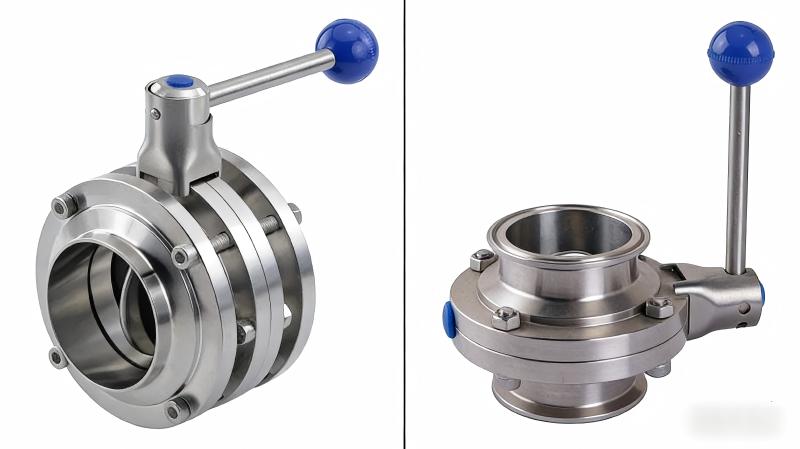
Description: Perhaps the most recognizable connection in sanitary processing, clamp valves feature specialized ferrules joined by a robust gasket and a quick-release clamp. This design ensures a tight, crevice-free seal, critical for preventing microbial ingress.
-
Distinct Advantages for Process Engineers:
-
Unrivaled Ease of Maintenance: Their hallmark is rapid assembly and disassembly. This makes them indispensable for systems necessitating frequent Clean-in-Place (CIP) or Sterilization-in-Place (SIP) cycles, allowing swift valve removal for inspection or component replacement with minimal downtime.
-
Superior Contamination Control: The smooth internal bores and the absence of threaded connections drastically reduce potential harboring points for bacteria, making them the go-to for dairy, craft brewing, and personal care formulations.
-
Adaptability for Evolving Processes: Their modular nature allows for quick reconfiguration of process lines, a significant benefit for facilities with varying production needs or R&D environments.
-
-
Ideal Operational Contexts: Batch processing, multi-product facilities, and any application where frequent, verifiable cleaning is a critical operational parameter.
-
-
Weld Type Valves: The Standard for Permanent, Ultra-Purity Applications
-
Description: Weld-end sanitary butterfly valves are engineered for permanent integration. They are butt-welded directly into the pipeline, forging a continuous, seamless extension of the fluid path.
-
Uncompromising Strengths:
-
Peak Hygienic Integrity: By eliminating mechanical joints and potential gasket interfaces, weld connections offer the highest possible level of hygienic security. This makes them indispensable for ultra-pure water systems and high-purity product lines.
-
Exceptional Structural Robustness: A properly welded connection delivers unmatched mechanical strength, easily withstanding high pressures and extreme temperatures without the risk of loosening or leakage over time.
-
Minimized Dead Space: The seamless integration ensures virtually no dead zones where product residue could accumulate, which is paramount in biopharmaceutical and semiconductor manufacturing.
-
-
Strategic Application: Essential for critical, non-disassembly-intensive processes in pharmaceutical API production, biotechnology bioreactors, and semiconductor chemical delivery where system integrity and trace-level contamination avoidance are paramount.
-
-
Wafer Type Valves: Efficient Integration within Flanged Systems
-
Description: Wafer butterfly valves are uniquely designed to be sandwiched between two existing pipe flanges. The valve body is secured by through-bolts that pass through both flanges and the valve itself.
-
Considerations for Sanitary Environments:
-
While clamp and weld designs dominate the core sanitary process lines, wafer valves offer a compact footprint and can be an economical solution for larger diameter utility lines (e.g., purified water, clean steam) within a sanitary facility, or for integration into pre-existing flanged infrastructure.
-
It’s crucial to select wafer designs with proper sanitary considerations, including robust seat materials and minimal body crevices, especially when used near product contact points.
-
-
Targeted Use Cases: Best deployed in less critical ancillary systems, larger diameter service lines, or where space constraints and existing flanged connections dictate the installation method.
-
II. Beyond Connection: Mastering Actuation Strategies for Optimal Control
Once the physical connection is determined, the method by which your sanitary butterfly valve operates is the next critical decision, dictating control precision, automation potential, and operational efficiency.
-
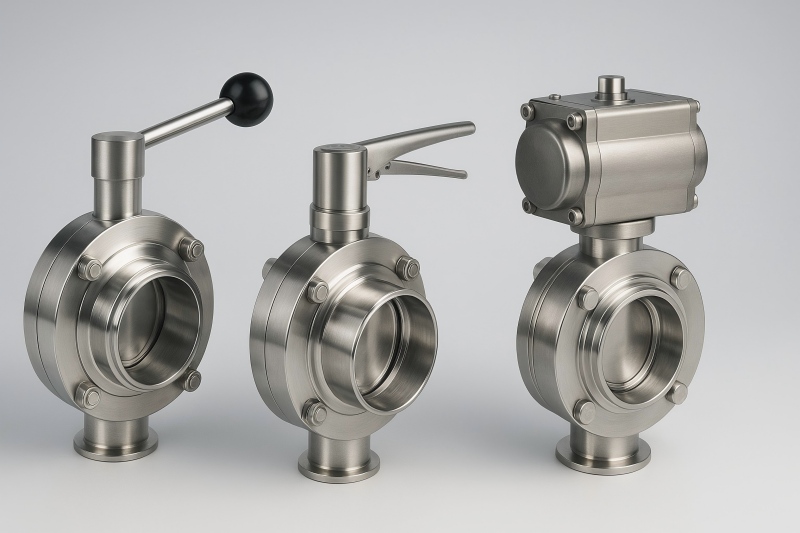
Manual Actuation: The Foundation of Simplicity and Economy
-
Description: These valves are operated directly by hand, typically via a lever or a geared handwheel for larger sizes. They offer a straightforward, direct means of flow control.
-
Value Proposition: Lowest initial cost, simplest installation, and immediate visual confirmation of valve position.
-
Limiting Factors: Requires physical operator presence, unsuitable for remote control or automated sequences, and less practical for frequently cycled lines.
-
Optimal Deployment: Seldom-accessed lines, utility services, or basic on/off applications where full automation is neither required nor cost-justified.
-
-
Pneumatic Actuation: The Industry Standard for Automated Sanitary Processes
-
Description: Pneumatic actuators harness compressed air to open and close the valve. They are commonly available in spring-return configurations (which default to open or closed upon air loss, offering a fail-safe mechanism) or double-acting designs for precise control in both directions.
-
Core Advantages for Process Automation: Exceptionally fast actuation speeds, high reliability, ideal for high-cycle applications, and seamless integration into sophisticated automated control systems. Their robustness makes them a workhorse in CIP/SIP routines and batch processing.
-
Operational Considerations: Requires a consistent supply of clean, dry compressed air, and can generate some operational noise.
-
Strategic Fit: The default choice for most automated food, beverage, and pharmaceutical processing lines where rapid, repetitive, and reliable valve operations are paramount.
-
-
Electric Actuation: Precision, Remote Control, and Advanced Modulation
-
Description: Electric actuators employ an electric motor to operate the valve. They excel in offering precise intermediate positioning and often come equipped with advanced feedback and diagnostic capabilities.
-
Key Differentiators: Superior precision for throttling or modulating flow rates, ideal for complex control loops, offers robust remote control functionality, and eliminates the need for a compressed air infrastructure.
-
Practical Trade-offs: Generally operate at slower speeds compared to pneumatic alternatives, higher upfront investment, and more complex electrical wiring requirements.
-
Niche Applications: Perfect for intricate dosing, precise blending operations, or any application demanding fine flow modulation and remote control where air supply is problematic or not feasible.
-
Sangyie Technology: Your Trusted Partner in Hygienic Flow Solutions
Selecting the appropriate sanitary butterfly valve—considering its connection type, actuation method, and compliant material specification (such as 316L stainless steel and FDA-approved seal materials)—is a critical decision that impacts process efficiency, product safety, and regulatory adherence.
At [Your Company Name], we are more than just a manufacturer; we are innovators dedicated to the design and production of premium hygienic valves, pumps, high-shear mixers, and pipeline fittings. Our commitment to research and development ensures our product line, particularly our versatile sanitary butterfly valves, meets and exceeds the stringent requirements of industries ranging from brewing and dairy to semiconductors and biotechnology.
Whether your project demands the rapid turnaround of a clamp valve for a CIP system, the uncompromising purity of a welded solution for a biopharmaceutical line, or the precise modulation of an electric actuated valve for intricate blending, our engineering expertise is at your service. We possess an intimate understanding of hygienic design principles, material science, and the critical importance of certifications like 3A and EHEDG.
Are you ready to elevate your fluid handling system's performance and compliance?
[Click Here to Contact Us / Visit our Website at www.sangyie.com / Email us at [info@sangyie.com]
Sangyie Technology — Engineering the Flow of Your Success.
The Ultimate Guide to Sanitary Ball Valves: Types, Applications & Selection Criteria
Hygienic Single Seat Diverter Valves: Your Essential Partner in Food, Pharma & Biotech Excellence
Related Article

DIN 11866 is the overarching standard for aseptic systems that uses DIN 11850 as its "Series A" option.