Why DIN 11866 Stainless Steel Tubes are Critical for Semiconductor Cleanrooms
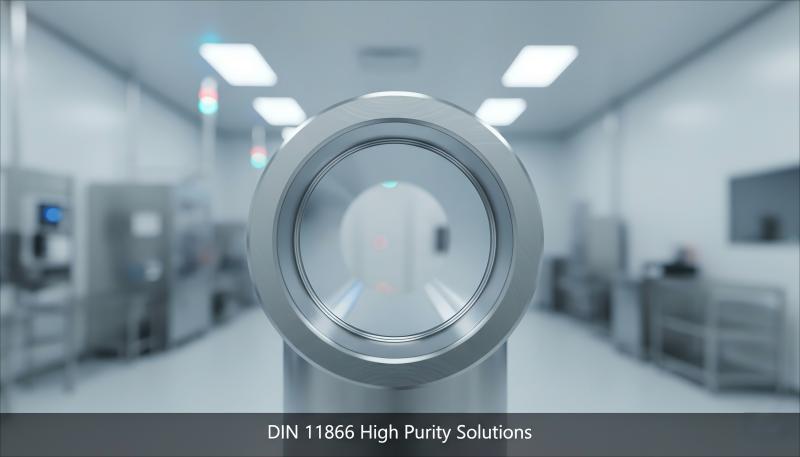
In the semiconductor industry, the margin for error is measured in nanometers. As chip nodes shrink and manufacturing processes become more complex, the purity of process fluids—such as Ultra-Pure Water (UPW), high-purity chemicals, and specialty gases—becomes the lifeline of the fabrication plant (Fab).
For facility engineers and procurement managers, choosing the right piping system is not just about transporting fluids; it is about preventing contamination. This is where the DIN 11866 standard becomes non-negotiable.
At Sangyie, we specialize in manufacturing sanitary valves, pumps, and high-purity piping components. We understand that in a semiconductor cleanroom, the quality of the tube determines the yield of the chip. Here is why DIN 11866 stainless steel tubes are the backbone of modern semiconductor fluid systems.
1. Superior Surface Finish (Ra) to Prevent Contamination
The biggest enemy in a semiconductor Fab is particulate contamination and bacterial growth (biofilm). Standard industrial pipes often have microscopic rough surfaces where particles can accumulate and bacteria can thrive.
DIN 11866 strictly regulates the Roughness Average (Ra) of the inner surface.
-
Why it matters: A lower Ra value means a smoother surface. This ensures that high-purity chemicals flow without residue retention and that UPW systems remain sterile.
-
Sangyie’s Solution: Our DIN 11866 tubes are available in H3 and H4 hygiene classes. For semiconductor applications, we offer Electropolished (EP) tubes with an inner surface roughness of Ra < 0.25μm. This mirror-like finish minimizes particle entrapment and ensures the highest level of cleanliness.
2. Precise Dimensional Tolerances for Orbital Welding
In high-purity piping systems, manual welding is rarely used due to the risk of human error and contamination. Instead, Orbital Welding (automatic TIG welding) is the industry standard.
Orbital welding requires tubes to have perfect geometry. If the wall thickness varies or the ovality is off, the weld heads will not align perfectly, leading to:
-
Misalignment gaps.
-
Dead legs where bacteria can grow.
-
Weld beads that protrude into the flow path.
DIN 11866 sets stricter tolerances for outer diameter (OD) and wall thickness compared to general industrial standards. At Sangyie, we utilize precision manufacturing to ensure our tubes and fittings have consistent dimensions, guaranteeing a 100% successful orbital weld every time.
3. High-Quality Material Composition (316L)
Not all stainless steel is created equal. The DIN 11866 standard typically specifies the use of 1.4404 (AISI 316L) or 1.4435 (AISI 316L High Molybdenum) stainless steel.
For semiconductor applications, material purity is critical:
-
Corrosion Resistance: The high molybdenum content protects the tubing from harsh etching chemicals and cleaning agents (CIP/SIP).
-
Controlled Delta Ferrite: Excessive ferrite content in the steel can lead to corrosion and magnetic interference. Sangyie strictly controls the chemical composition of our raw materials to meet the stringent demands of the semiconductor supply chain.
4. Full Traceability and Documentation
In the semiconductor industry, traceability is mandatory. If a contamination event occurs, engineers need to trace every component back to its source.
DIN 11866 requires rigorous marking and certification. At Sangyie, every length of tube and every fitting we ship comes with:
-
Laser marking for permanent identification (Heat No., Material, Size, Standard).
-
EN 10204 3.1 Material Certificates.
-
Full traceability from the raw material melt to the final finished product.
Why Choose Sangyie for Your Cleanroom Project?
As a manufacturer dedicated to R&D and innovation, Sangyie goes beyond just selling pipes. We provide a complete sanitary fluid handling ecosystem—from sanitary pumps and high-shear mixers to the valves and fittings that connect them.
Whether you are building a new Fab or upgrading an existing high-purity gas delivery system, our DIN 11866 compliant products ensure:
-
Compliance: Meeting FDA, EHEDG, and ASME BPE standards alongside DIN.
-
Availability: Wide range of DIN 11866 Series A, B, and C sizes in stock.
-
Expertise: A team that understands the difference between food-grade and semiconductor-grade requirements.
Ready to Optimize Your High-Purity System?
Don't compromise on your process yield. Ensure your facility is equipped with the best DIN 11866 stainless steel components.
[Click Here to Contact Us / Visit our Website at www.sangyie.com / Email us at [info@sangyie.com]
Sangyie Technology — Engineering the Flow of Your Success.
Season's Greetings from Sangyie: Celebrating a Year of Purity and Innovation
Sanitary Air Relief Valve vs. Standard Air Compressor Relief Valve: Key Differences for Industrial Buyers
Related Article

DIN 11866 is the overarching standard for aseptic systems that uses DIN 11850 as its "Series A" option.