Batch vs. Inline High Shear Mixers: Which is Best for Your Sanitary Process?
In the competitive landscapes of food and beverage processing, pharmaceutical manufacturing, and biotechnology, achieving perfect product consistency is not just a goal—it’s a requirement.
For production managers and process engineers, one of the most common dilemmas is choosing the right mixing technology. Should you stick with the traditional Batch High Shear Mixer (tank-mounted), or upgrade to a continuous Sanitary Inline Mixer?
While both have their place in industrial applications, the shift towards continuous manufacturing has made inline mixers increasingly popular. As a professional manufacturer of sanitary fluid handling equipment, we are breaking down the technical differences, efficiency data, and hygiene standards to help you make an informed decision.
Understanding the Basics: How They Work
Before diving into the data, it is crucial to understand the fundamental operational differences.
What is a Batch High Shear Mixer?
A Batch Mixer is immersed directly into a vessel or tank. It draws material from the bottom or center of the tank and forces it through a stator. It continues to recirculate the product until the entire batch is deemed mixed.
-
Best for: Small volumes, frequent recipe changes, or processes requiring long hydration times.
What is a Sanitary Inline Mixer?
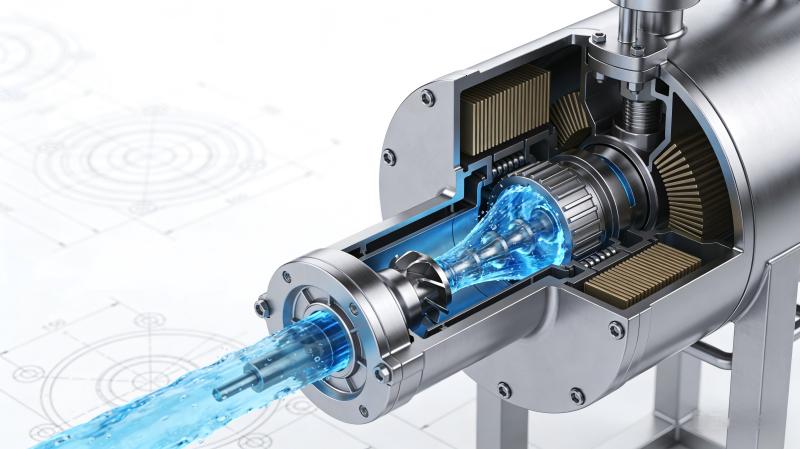
A Sanitary Inline Mixer operates as part of the pipeline. It is similar to a centrifugal pump but features a precision-engineered rotor-stator workhead. The product is mixed instantly as it passes through the housing.
-
Best for: Continuous production, large volumes, and processes requiring 100% uniformity.
-
Note: Our inline mixers are designed with standard Tri-clamp or Flange connections, making them easy to integrate with your existing Sanitary Tubing and piping systems.
Key Comparison: Efficiency, Quality, and Hygiene
For industrial hardware buyers, three factors usually drive the purchase decision: Speed, Consistency, and Cleanability.
1. Production Efficiency and Speed
Batch Mixers are limited by the tank size and the turnover rate of the fluid. In high-viscosity applications (e.g., cosmetic creams or sauces), simply moving the product to the mixing head can take time, often requiring auxiliary agitators.
Inline Mixers, conversely, offer a significant reduction in processing time—often up to 90%.
-
The Data: Because the product is forced through the high-shear zone in a single pass (or controlled recirculation), there is no bypassing. An inline mixer running at 3,000 RPM can process thousands of liters per hour, instantly discharging the finished product to the next stage (e.g., filling or heat exchange).
2. Product Consistency (Homogeneity)
In a tank (Batch), there is always a risk of "dead spots"—areas where the product does not circulate effectively through the shear head. This leads to stratification or inconsistent particle sizes.
With a Sanitary Inline Mixer, the "Single-Pass" principle ensures that 100% of the fluid goes through the rotor-stator assembly.
-
Why it matters: For pharmaceutical and semiconductor applications where particle size distribution must be precise (often sub-micron levels), inline mixing offers the statistical certainty that batch mixing cannot guarantee.
3. Hygiene and CIP/SIP Capabilities
As a manufacturer serving the Bio-pharm and Food industries, we understand that hygiene is non-negotiable.
-
Batch Issues: Cleaning a large tank with a mounted mixer often requires high volumes of water and manual scrubbing of the shaft and propeller.
-
Inline Advantage: Our Sanitary Inline Mixers are designed for CIP (Clean-In-Place) and SIP (Sterilize-In-Place).
-
Material: Constructed from high-grade 316L Stainless Steel.
-
Surface Finish: Standard internal finishes of Ra < 0.8µm (or lower upon request) prevent bacterial growth.
-
Self-Pumping: In many configurations, the mixer’s pumping action aids the cleaning fluid's velocity, ensuring a thorough wash without disassembly.
-
Industry Applications: When to Choose Inline?
Food & Beverage (Mayonnaise, Sauces, Soft Drinks)
When producing emulsions like mayonnaise, adding oil to water requires high shear energy to create stable droplets. An inline mixer installed before the storage tank ensures a stable emulsion immediately, preventing separation.
Pharmaceuticals & Biotech
For vaccine production, sterile suspensions, or active ingredient dispersion, the enclosed system of an inline mixer minimizes the risk of airborne contamination—a critical advantage over open-tank batch mixing.
Personal Care (Shampoos, Lotions)
Inline mixers are excellent for "Cold Process" manufacturing, rapidly blending surfactants and water while inline, saving the energy costs associated with heating large batch tanks.
Quick Comparison Table
| Feature | Batch High Shear Mixer | Sanitary Inline Mixer |
|---|---|---|
| Process Type | Discrete Batches | Continuous or Recirculation |
| Efficiency | Lower (Time-consuming) | High (Instant/Rapid) |
| Uniformity | Variable (Risk of dead spots) | 100% Consistent (No bypass) |
| Aeration | High (Vortex can entrap air) | Aeration-Free (Closed system) |
| Cleaning | Manual/Spray Ball required | CIP/SIP Ready |
| Space | Requires large tanks | Compact, fits in pipeline |
Factors to Consider Before Buying
If you decide an Inline Mixer is right for you, our engineering team needs the following data to size the equipment correctly:
-
Viscosity (cP): For products over 500 cP, you may need a Sanitary Rotary Lobe Pump to feed the mixer.
-
Flow Rate: We match the mixer size to your desired throughput (GPM or LPH).
-
Solids Content: If you are dissolving powders (like gums or thickeners), we recommend our specific "Shear Pump" configurations designed for powder induction.
Conclusion
While Batch Mixers serve their purpose in small-scale or highly variable productions, the Sanitary Inline Mixer is the superior choice for modern manufacturers seeking efficiency, repeatability, and strict hygiene compliance.
At Sangyie, we specialize in manufacturing high-quality sanitary mixers, pumps, valves, and fittings specifically for the food, pharma, and semiconductor industries.
Ready to optimize your production line? Contact our engineering team today for a free consultation. We can help you select the perfect inline mixer configuration to match your pipeline specifications.
[Click Here to Contact Us / Visit our Website at www.sangyie.com / Email us at [info@sangyie.com]
Sangyie Technology — Engineering the Flow of Your Success.
Hygienic Manhole Tank Cover 316L Stainless Steel: The Ultimate Guide for Sanitary Applications
What is a Sanitary Ball Valve and How Does It Work?
Related Article

DIN 11866 is the overarching standard for aseptic systems that uses DIN 11850 as its "Series A" option.