The Invisible Line of Defense: How ASME BPE-2024 Safeguards Every Drop of Medicinal Fluid
The Invisible Line of Defense: How ASME BPE-2024 Safeguards Every Drop of Medicinal Fluid
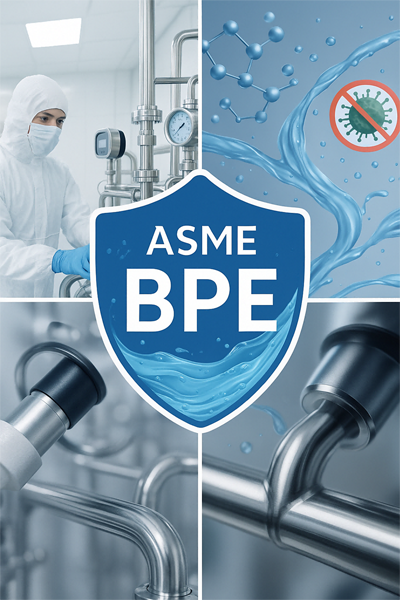
In the pristine environment of a biopharmaceutical production line, stainless steel pipes stretch silently, carrying precious medicinal fluids. To the naked eye, surfaces might appear flawlessly shiny, but under a microscope, a scratch as tiny as 0.5 microns can become a formidable "fortress" for microorganisms, jeopardizing an entire batch of drugs. It is this battle for microscopic precision that has given rise to the gold standard in the biopharmaceutical industry: the ASME BPE standard. In April 2024, this critical safety specification, which truly impacts lives, received its latest upgrade: ASME BPE-2024.
I. ASME BPE: The Genetic Code for Bioprocessing Equipment
ASME BPE, which stands for the Bioprocessing Equipment standard, is developed by the American Society of Mechanical Engineers. It is specifically designed for high-purity industries such as biopharmaceuticals and high-end personal care products. It acts like a stringent "genetic code" or a comprehensive blueprint, defining the fundamental safety requirements of equipment from material selection and surface finish to welding procedures and comprehensive inspection throughout the equipment's lifecycle.
Unlike general industrial standards, the BPE standard zeroes in on one core question: How to completely prevent contamination of drugs during the production process? It stipulates that all equipment components that come into contact with the drug product, raw materials, or process media (such as Water for Injection (WFI), pure steam, process gases) – including piping, bioreactors, valves, and pumps – must adhere to the "Three No's" principle: no adsorption of drug substances, no chemical reactions, and no release of harmful substances.
Moreover, the BPE standard does not stand alone. When equipment involves pressure systems, it must simultaneously comply with the ASME Boiler and Pressure Vessel Code (Section VIII) and the Process Piping Standard (ASME B31.3), forming a triple layer of protection to ensure equipment safety and reliability even under extreme conditions.
II. The Microscopic Battlefield: Surface Finish Determines Success
In pharmaceutical equipment, up to 90% of product-contact surfaces originate from piping and fittings. The risk of microbial contamination decreases exponentially with every 0.1-micron reduction in surface roughness. The latest ASME BPE-2024 standard categorizes surface finishes into 7 levels (SF0-SF6), with two grades being particularly crucia
| Surface Grade | Processing Method | Typical Roughness Ra (μm) | Key Advantages & Application Scenarios |
|---|---|---|---|
| SF1 | Mechanical Polishing | < 0.51 | Lower cost, suitable for general fluid systems or low-risk areas. |
| SF4 | Electropolishing (EP) | < 0.38 | Premium Choice: Eliminates microscopic burrs, forms a passive film, significantly enhances corrosion resistance. Commonly used for WFI, pure steam, and high-purity media systems. |
| SF5 | Ultra-High Precision EP | < 0.25 | For advanced biologics like monoclonal antibodies and vaccines, achieving near-molecular smoothness to minimize product adsorption and contamination. |
Why has Electropolishing (EP) become the preferred choice for high-end biopharmaceutical equipment? Through precise electrochemical dissolution, EP removes approximately 20 microns of the surface metal. This not only results in a mirror-like finish but also generates a dense, stable, chromium-rich passive film on the surface, which boosts corrosion resistance by over 3 times compared to mechanical polishing.
A cautionary tale from a biopharmaceutical company underscores this: When the Ra value of their lyophilizer's inner wall was reduced from 1.2μm to 0.4μm, the adsorption rate of high-value protein drugs plummeted from 3.2% to below 0.5%, saving the company tens of millions of CNY annually in product loss. This vividly demonstrates that in the "surface war" at the microscopic level, even a hair's breadth can determine success, safety, and profitability.
III. From Welds to Slopes: The Devil in the Details
In the ASME BPE philosophy, every minute detail can become a breach point for contamination.
1. Welding: The Art of Seamlessness Welds are often "hotbeds" for contamination risks in biopharmaceutical equipment. BPE-2024 imposes stringent welding requirements:
-
Automatic Welding Preferred: Minimizes human variability and ensures weld consistency.
-
Material Compatibility: Weld material must precisely match the base material (e.g., 316L with 316L filler wire).
-
Strict Inner Surface Control: Weld seam internal concavity must not exceed 10% of the wall thickness, and 100% boroscopic inspection is mandatory.
-
Boroscope's "Eye of Truth": High-precision boroscopes can penetrate up to 30 meters into piping, capturing millimeter-sized defects, and even clearly identifying discoloration in the heat-affected zone. Acceptable welds exhibit a silver-white or pale gold hue; any deep blue or purple indicates non-compliance and requires immediate rework.
2. Zero-Retention Design: Gravity as the Ultimate Cleaning Aid To completely eliminate liquid retention and prevent microbial growth, ASME BPE specifies precise slopes for pipes and vessels:
-
Long Pipe Runs: A minimum slope of 1% (1 cm drop per meter) is required for efficient drainage.
-
Pump Inlet Sections: Must have a steeper slope of at least 2% to prevent liquid pooling.
-
CIP Return Lines: A minimum slope of 0.5% ensures complete return flow of cleaning solutions. For instance, Alfa Laval's Tri-Clover hygienic piping systems exemplify this principle: their elbows utilize single-piece forming technology, and reducer wall thickness deviations are strictly controlled to ≤0.1mm, eliminating potential leak points and liquid stagnation from the source.
IV. Material Revolution & Identity Authentication: Purity at the Source
Material selection is the first line of defense for purity under ASME BPE. Equipment in direct contact with medicinal fluids must use ultra-low carbon austenitic stainless steel 316L, with its sulfur content strictly controlled to ≤0.030% – over 10 times stricter than general industrial steel. This stringent requirement aims to minimize material leaching and corrosion risks to the drug fluid.
Notably, the ASME BPE-2024 standard further regulates the application of even higher-grade materials, such as duplex stainless steel and super austenitic steel. These materials offer superior corrosion resistance and strength, particularly suited for cutting-edge fields like monoclonal antibodies and cell therapies, which demand extreme production environment purity.
Beyond material compliance, traceability is another critical safeguard emphasized by ASME BPE. For example, a leading equipment manufacturer, Siny (Newland) Group, begins detailed record-keeping for their heat exchangers right from raw material inbound inspection: every steel plate's melt number, polishing parameters, and welding records are digitally documented, forming a comprehensive "from melt to equipment" lifecycle file. This detailed "identity authentication" ensures transparency of every component's origin and processing, providing ultimate assurance for drug safety.
V. ASME BPE-2024: Digital Empowerment & Green Upgrades – Unlocking New Industry Possibilities!
As the latest version, ASME BPE-2024 incorporates the most recent advancements and trends in global biopharmaceutical technology, introducing several revolutionary breakthroughs that lead the industry towards a more efficient, intelligent, and sustainable future:
-
Duplex Stainless Steel Welding Guidelines: The new standard for the first time includes specific welding guidelines for duplex stainless steel, precisely controlling heat input to prevent sigma phase precipitation, thereby effectively addressing corrosion issues caused by high chloride ion drug solutions, and expanding material application scope.
-
Digital Delivery Empowerment: This is a revolutionary step. BPE-2024 explicitly requires automated recording and blockchain immutability for critical parameters (such as current, time, and roughness in surface treatment). This fully complies with FDA's ALCOA+ principles (Attributable, Legible, Contemporaneous, Original, Accurate, and now Complete, Consistent, Enduring, Available), significantly enhancing data integrity and traceability, and supporting enterprises' digital transformation.
-
Integration of Green Manufacturing Concepts: For the first time, green manufacturing and sustainability principles are incorporated into the standard. This includes promoting nitric acid-free electropolishing and passivation processes (e.g., citric acid-hydrogen peroxide systems) to replace traditional acid pickling. This can reduce hazardous waste emissions by 30% annually, aligning with growing global environmental demands.
-
Modularization and Single-Use Technologies Integration: Addressing the increasing demand for flexibility and efficiency in the biopharmaceutical sector, the new standard provides clearer, more forward-looking guidance for modular systems and Single-Use (SU) technologies, helping companies rapidly deploy new production lines, effectively mitigate cross-contamination risks, and accelerate time-to-market.
It is clear that equipment compliant with ASME BPE-2024 will become the "essential standard" for future high-efficiency, safe, and compliant bioprocessing production lines.
VI. More Than Just a Standard: A Passport to Global Biopharma
In the fiercely competitive global biopharmaceutical landscape, ASME BPE is no longer merely a technical specification; it is the "hard currency" of quality and a "passport" to global markets. It is due to this standard that Chinese-manufactured hygienic heat exchangers can obtain EU PED certification, and domestic insulin production lines can successfully pass stringent FDA audits.
Compared to the 3-A Sanitary Standards for the food industry, ASME BPE imposes far more stringent requirements on surface roughness, slope design, and material traceability. While the initial cost may be 15%-20% higher, it is an indispensable path for enterprises to successfully penetrate global pharmaceutical supply chains and earn international market trust.
As advanced therapies such as CAR-T cell therapy, mRNA vaccines, and gene therapies rapidly emerge, the significance of ASME BPE-2024 is elevated to new heights. It is no longer just an equipment design specification, but the underlying architecture that ensures innovative drugs safely transition from development to production, ultimately benefiting every patient. These meticulous defenses built in the microscopic world ultimately safeguard the very lifeblood of every medicine user.
Our Company: Your Reliable Partner for ASME BPE-2024 Compliance
As a professional company deeply rooted in foreign trade and specialized in the supply of high-purity equipment and materials, we not only possess profound knowledge of international trade regulations but also a deep understanding of cutting-edge biopharmaceutical equipment technology and the core requirements of the ASME BPE standard. We recognize the critical impact of ASME BPE-2024 on your business and are committed to providing you with unparalleled value:
-
Global Supplier Vetting: We meticulously select top-tier international manufacturers and high-quality products that strictly adhere to the latest ASME BPE-2024 standard, especially its stringent requirements for materials, welding, surface finish, and traceability. Every piece of equipment undergoes our rigorous professional quality control.
-
Expert Technical Consultation: Our team of technical consultants possesses in-depth knowledge and extensive practical experience with the ASME BPE standard. We can provide professional procurement advice and technical support tailored to your specific application needs, ensuring that your chosen solutions fully meet the most demanding production requirements.
-
Efficient & Reliable Delivery: Leveraging our extensive international trade experience and well-established logistics network, we ensure that ASME BPE-2024 compliant equipment is delivered seamlessly and efficiently from the source to your facility, ensuring your projects launch on time and production remains uninterrupted.
Choosing us means choosing ultimate purity, exceptional efficiency, and a compliant pathway to global markets.
How to Choose the Right Butterfly Valve for Efficient Fluid On/Off Control
Conquering Clogging & Abrasion: Choosing the Right Valve for Slurries & Viscous Liquids
Related Article

DIN 11866 is the overarching standard for aseptic systems that uses DIN 11850 as its "Series A" option.