What is the Main Purpose of a Hygienic Vacuum Pump? Protecting Purity in Critical Processes
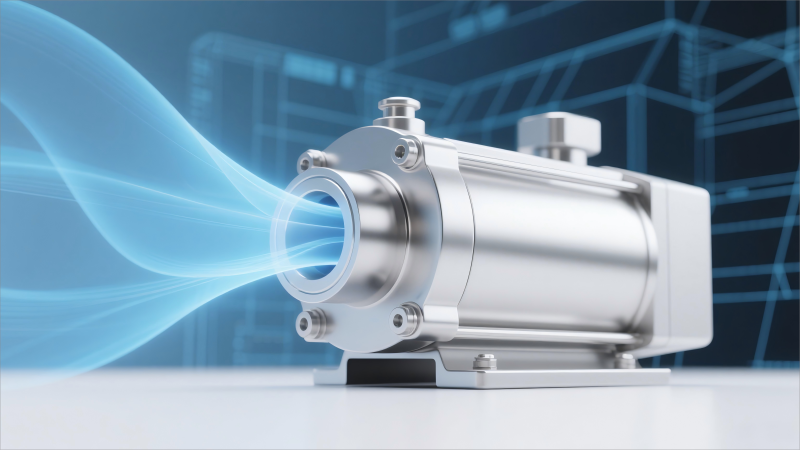
In industries where purity is paramount—such as pharmaceuticals, biotechnology, food and beverage, and cosmetics—every component in the processing line is under scrutiny. While equipment like valves, mixers, and tanks are often in the spotlight, another critical device works diligently behind the scenes: the hygienic vacuum pump.
But what exactly is its main purpose?
While a standard industrial vacuum pump's job is simply to remove air and create negative pressure, a hygienic vacuum pump has a far more profound and critical mission.
The Core Purpose: Creating a Pure Vacuum Environment
The main purpose of a hygienic vacuum pump is not just to create a vacuum, but to do so within an environment that guarantees the absolute purity and integrity of the product.
This purpose can be broken down into two essential functions:
-
Process Optimization: It enables or enhances specific production processes that require a controlled, low-pressure environment.
-
Contamination Prevention: It performs its function without introducing any contaminants (like oil, particulates, or microorganisms) into the product or the system.
This dual function is what separates a hygienic pump from a standard one and makes it indispensable in sensitive applications.
How Does it Fulfill This Purpose? Key Design Features
Our hygienic vacuum pumps are engineered from the ground up to meet these stringent demands. The purpose is reflected in every aspect of their design:
-
Material Integrity: All wetted parts (surfaces in contact with the process medium) are constructed from high-grade stainless steel, typically AISI 316L, which offers superior corrosion resistance and is non-reactive with sensitive products.
-
Sanitary, Crevice-Free Design: The internal surfaces are polished to a high finish (e.g., Ra < 0.5 μm) and are designed to be free of dead zones, gaps, or crevices. This self-draining and smooth profile prevents product buildup and microbial growth, making it fully compatible with Clean-in-Place (CIP) and Sterilize-in-Place (SIP) procedures.
-
Contamination-Free Operation: Many of our models utilize technologies like the liquid ring principle, which uses a sealing fluid (typically water) instead of oil. This completely eliminates the risk of oil mist or vapor contaminating the vacuum stream and, ultimately, the final product.
-
Certified Sealing: We use FDA-compliant and USP Class VI certified seals and gaskets. These ensure a perfect hermetic seal, preventing both leaks from the system and contaminants from entering it.
Real-World Applications: Where the Purpose Becomes Reality
Understanding the main purpose is best done by seeing it in action. Here’s how our hygienic vacuum pumps serve critical functions across various industries:
-
In the Pharmaceutical & Biotech Industry:
-
Purpose: To create a sterile vacuum for processes like vacuum drying (lyophilization), distillation, and crystallization.
-
Benefit: It gently removes moisture and solvents at low temperatures, protecting heat-sensitive active pharmaceutical ingredients (APIs) and biological compounds from degradation. The sterile environment is non-negotiable for product safety.
-
-
In the Food, Dairy & Beverage Industry:
-
Purpose: For deaeration or degassing of liquids like milk, juice, sauces, and oils.
-
Benefit: Removing dissolved oxygen prevents oxidation, which preserves flavor, color, and vital nutrients. This extends the product's shelf life and improves its quality and stability.
-
-
In the Cosmetics & Personal Care Industry:
-
Purpose: To remove air bubbles from creams, lotions, gels, and ointments during mixing and emulsification.
-
Benefit: A vacuum environment ensures a smooth, homogenous, and stable product with an appealing appearance. It also prevents the product from oxidizing in the container.
-
-
In Semiconductor Manufacturing:
-
Purpose: To create ultra-clean vacuum conditions for processes like chemical vapor deposition and etching.
-
Benefit: Even microscopic particles can ruin a microchip. A hygienic, oil-free vacuum is essential to maintain the pristine environment required for manufacturing flawless semiconductors.
-
Conclusion: More Than a Component, It's a Commitment to Quality
So, what is the main purpose of a hygienic vacuum pump? It is to be the unseen guardian of your product's purity. It is an enabler of efficiency and a critical control point for quality assurance.
As a manufacturer of a comprehensive range of hygienic solutions—from valves and fittings to high-shear mixers—we understand that every part of your system must work in perfect harmony. Our hygienic vacuum pumps are designed not as standalone units, but as integral components of a complete, reliable, and pristine processing line.
Choosing the right vacuum pump is an investment in product safety, process reliability, and your brand's reputation.
Have a specific application in mind? Contact our technical experts today to discuss how our hygienic vacuum solutions can safeguard the integrity of your process.
[Click Here to Contact Us / Visit our Website at www.sangyie.com / Email us at [info@sangyie.com]
Sangyie Technology — Engineering the Flow of Your Success.
More Than Just a Connection: The DIN 11851 Union
What is DIN 11866? A Guide to the Standard for Ultimate Purity
Related Article

DIN 11866 is the overarching standard for aseptic systems that uses DIN 11850 as its "Series A" option.