When the pump is installed above the liquid level, which type ensures reliable and efficient operation?
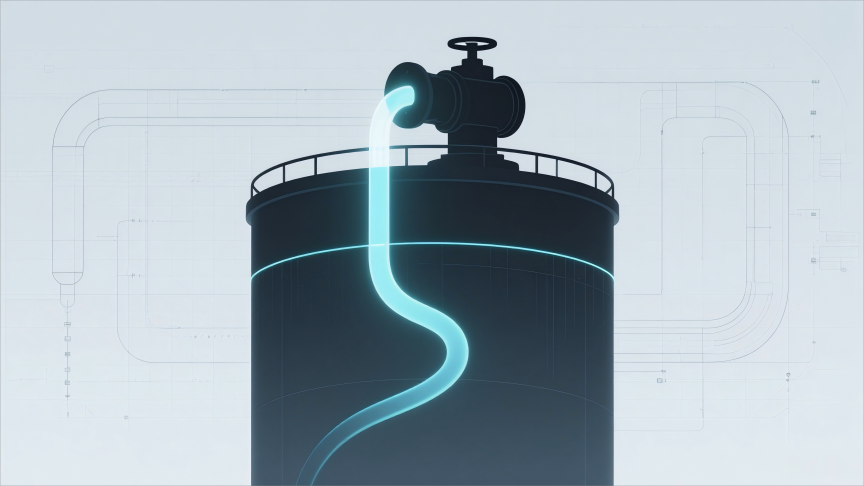
Plant layout constraints, tank design, safety protocols, or the need to empty tankers and totes from the top often require the pump to be placed above the liquid level. This arrangement, known as a suction lift application, presents a significant challenge: the pump must first evacuate air from the suction line before it can begin moving liquid.
So, which pump is the right tool for this demanding job?
The Problem with Standard Centrifugal Pumps
Let's start with what usually doesn't work. A standard centrifugal pump is the workhorse of many industries, but it has a critical limitation: it is designed to pump liquid, not air.
When a standard centrifugal pump starts in a suction lift condition, its impeller spins in the air trapped in the suction line. Since air is far less dense than liquid, the impeller cannot create enough pressure differential to draw the liquid up. This results in a condition called "air lock" or "loss of prime," where the pump runs without moving any fluid, potentially leading to overheating and mechanical seal failure.
To make a standard centrifugal pump work in this scenario, an external priming system, such as a foot valve and an initial manual fill of the suction line, is required. This adds complexity, a potential point of failure, and is often impractical in sanitary applications.
The Solution: Self-Priming Pumps
The answer lies in a category of pumps specifically designed to overcome this challenge: self-priming pumps. These pumps have an integrated mechanism to evacuate air from the suction line, create a vacuum, and lift the liquid to the pump inlet, all without manual intervention.
Let's explore the most reliable and commonly used types in sanitary industries.
A Liquid Ring Pump is a type of positive displacement pump that is exceptionally effective at handling air. It is often the top choice for applications involving suction lift, especially for Clean-in-Place (CIP) return systems.
-
How it Works for Self-Priming: The pump's casing is designed to retain a pool of liquid (the "liquid ring"). As the vaned impeller rotates eccentrically within the casing, it forces this liquid against the outer wall, forming a moving ring. The spaces between the impeller vanes and the liquid ring expand and contract, creating sealed chambers. On the suction side, these chambers expand, creating a powerful vacuum that pulls air and then liquid from the suction pipe. The air-liquid mixture is then compressed and discharged.
-
Key Advantages:
-
Excellent air-handling capability.
-
Can handle foams, and some entrained solids and gas.
-
Smooth, non-pulsating flow.
-
-
Ideal Applications:
-
CIP Return: The classic application. It can efficiently empty tanks and lines of cleaning solutions, even when the flow is intermittent and mixed with air.
-
Tanker & Tote Unloading: Efficiently emptying containers from the top.
-
Evacuation & Vacuum Duties: Creating a vacuum in process vessels.
-
This is not your standard centrifugal pump. It features a special casing design with a large "priming chamber" that traps a reservoir of liquid after the initial prime.
-
How it Works for Self-Priming: When the pump starts, the impeller churns the liquid in the priming chamber, mixing it with the air from the suction line. This mixture is discharged into the chamber, where the air separates and is expelled through the discharge port, while the heavier liquid falls back to be remixed. This process repeats, gradually creating a vacuum in the suction line until all the air is purged and the pump begins to operate like a standard centrifugal pump.
-
Key Advantages:
-
Higher efficiency than many other self-priming types once primed.
-
Combines the simplicity of a centrifugal pump with self-priming capability.
-
-
Ideal Applications:
-
Sump emptying.
-
Fluid transfer from underground tanks.
-
Unloading clear or low-viscosity liquids like milk, juice, or WFI (Water for Injection) where efficiency is key.
-
While primarily known for their ability to handle viscous and shear-sensitive products, rotary lobe and twin screw pumps, both types of positive displacement pumps, also possess inherent self-priming capabilities.
-
How it Works for Self-Priming: The tight clearances between the rotors (lobes or screws) and the pump casing create seals. As the rotors turn, they create expanding cavities on the suction side, generating a vacuum. However, their priming ability is most effective when the internals are "wetted" (coated with the process fluid), as this improves the seal. They are not as adept at handling large volumes of dry air as a liquid ring pump.
-
Key Advantages:
-
Extremely gentle product handling, minimizing shear.
-
Excellent for high-viscosity products (creams, gels, sauces).
-
Can run dry for short periods (depending on seal configuration).
-
-
Ideal Applications:
-
Unloading viscous products like cosmetic creams, yogurt, or fruit purees from totes where the pump is located above the container.
-
Any application requiring both gentle handling and a moderate suction lift.
-
Quick Comparison Chart
| Pump Type | Self-Priming Principle | Key Advantage | Best For... |
|---|---|---|---|
| Liquid Ring Pump | Creates a liquid ring to act as a liquid piston, compressing and expelling air. | Superior air-handling, tolerant of foams & gas. | CIP return, tanker unloading, vacuum duties. |
| Self-Priming Centrifugal | Uses a fluid reservoir to mix with and expel air from the suction line. | High efficiency once primed, simple operation. | Transfer of low-viscosity fluids (water, milk, beverages). |
| Lobe / Twin Screw Pump | Meshing rotors create a vacuum. Most effective when wetted. | Gentle product handling, high viscosity capability. | Transferring viscous or shear-sensitive products (creams, gels, food ingredients). |
Conclusion: Making the Right Choice
When your pump must be installed above the liquid level, a self-priming pump is not just an option—it's a necessity for reliable and automated operation. Standard centrifugal pumps will fail to perform without complex and often unreliable external aids.
The best choice depends entirely on your application:
-
For CIP return or handling gassy fluids, the Liquid Ring Pump is the industry standard.
-
For efficient transfer of low-viscosity liquids, a Self-Priming Centrifugal Pump is an excellent choice.
-
For viscous or shear-sensitive products, a Lobe or Twin Screw Pump provides the gentle handling you need with effective priming power.
Navigating the complexities of fluid dynamics and pump selection can be challenging. At Sangyie Technology, we specialize in providing high-quality, sanitary pumping solutions for the world's most demanding industries. Our experts are ready to analyze your specific process requirements—from fluid characteristics to plant layout—to recommend the perfect pump that ensures efficiency, reliability, and product integrity.
Facing a suction lift challenge? Contact us today to speak with an application engineer and find your solution.
[Click Here to Contact Us / Visit our Website at www.sangyie.com / Email us at [info@sangyie.com]
Sangyie Technology — Engineering the Flow of Your Success.
What is DIN 11866? A Guide to the Standard for Ultimate Purity
Choosing the Right Connection: Your Essential Guide to the DIN 11851 Hygienic Standard
Related Article

DIN 11866 is the overarching standard for aseptic systems that uses DIN 11850 as its "Series A" option.