The Benchmark of Precision: A Deep Dive into the German DIN Hygienic Standard
Hello and welcome back to our expert series on hygienic standards!
After exploring the Swedish SMS and the British RJT, we now turn our focus to a global benchmark for manufacturing excellence: Germany. This is the origin of the DIN standard, a name synonymous with precision, rigor, and superior hygienic design.
As a manufacturer serving cutting-edge sectors like pharmaceuticals, biotechnology, and semiconductors, we know that when a customer's requirement evolves from "reliable" to "absolutely sterile," the DIN standard is often where the conversation begins. So, what gives this "German benchmark" its revered status? Let's take a closer look.
1. What is the DIN Standard?
DIN is the acronym for Deutsches Institut für Normung, or the German Institute for Standardization. Its specifications are recognized worldwide as a hallmark of quality and technical superiority. In the context of hygienic pipelines, we are typically referring to DIN 11851 (for sanitary threaded pipe couplings) and its companion standard, DIN 11850 (for hygienic stainless steel tubes).
If SMS is defined by simplicity and RJT by robustness, the core philosophy of the DIN standard is the systematic elimination of hygienic dead space.
2. The Core of a DIN Union: The Precision Quartet
Every component of a standard DIN 11851 hygienic union is a masterclass in clean design:
-
Threaded Male Part (Gewindestutzen): The externally threaded male part, compliant with DIN specifications.
-
Weld Male Liner (Kegelstutzen): This part is welded to the pipe or equipment port. Its internal profile is engineered to create a perfectly flush and seamless transition with the gasket and mating part.
-
Slotted Round Nut (Nutmutter): Similar to SMS, it uses a round nut with side slots, designed for use with a C-spanner.
-
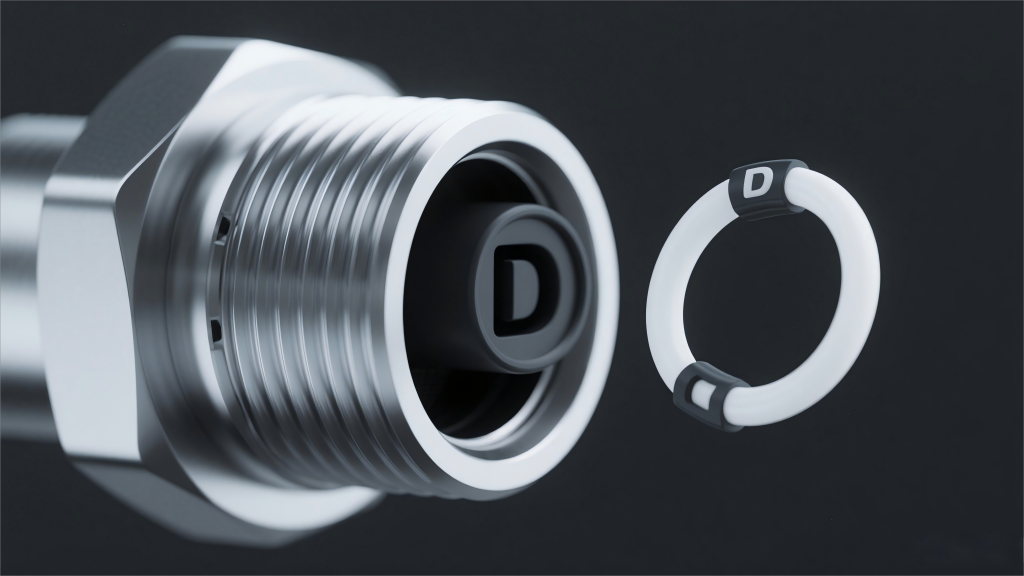
D-Ring Gasket: This is the soul of the DIN standard and its most identifiable feature. It has a unique "D-shaped" cross-section.
The genius of this design lies in:
-
Crevice-Free Connection: The D-ring gasket fits perfectly into a specially designed groove. When tightened, it fills the space to form an almost perfectly smooth and continuous inner surface with the metal parts. This design dramatically minimizes the risk of product residue and microbial contamination.
-
Metal-to-Metal Support: Once properly assembled, the two metal liners make firm contact. This provides added stability and rigidity to the connection while protecting the gasket from over-compression and extrusion.
3. Why is DIN the Standard of Choice for High-Purity Applications?
With its unparalleled hygienic design, the DIN standard has become the gold standard in industries where cleanliness is non-negotiable.
-
Pharmaceuticals & Biotechnology: In these fields, the slightest contamination can compromise an entire batch. The crevice-free design of DIN unions makes them the ideal choice for transporting valuable and sensitive media, and they are fully compliant with rigorous CIP (Clean-in-Place) and SIP (Sterilize-in-Place) protocols.
-
High-End Food & Beverage: For applications like infant formula, premium dairy products, and aseptic filling, the DIN standard provides the highest level of safety and assurance.
-
International Recognition & Compatibility: As one of the most widely used standards in Europe, DIN enjoys exceptional recognition and interchangeability in international projects.
The Ultimate ID Guide: Telling the Big Three Apart By now, you should be a standards expert. Here is the definitive way to identify them:
-
Look at the Nut: Hexagonal → RJT. Slotted Round Nut → SMS or DIN.
-
Look at the Gasket (The Deciding Factor):
-
D-Shaped Cross-Section → DIN (Looks like the letter 'D')
-
O-Ring (Circular Cross-Section) → RJT
-
Square or L-Shaped Cross-Section → SMS Remember: The dimensions, threads, and sealing designs are completely different. They are never interchangeable!
-
4. Our Promise: German Standards, Global Quality
At Sangyie Technology, we don't just manufacture products; we replicate and perfect the essence of each standard. Our own commitment to precision aligns perfectly with the philosophy behind DIN.
-
Strict Tolerance Control: Every DIN-standard valve, pump, and fitting we produce is machined on advanced CNC equipment. We maintain strict control over dimensional tolerances and surface finishes (Ra values as low as 0.4μm) to guarantee a perfect fit and seal.
-
Certified High-Grade Materials: We insist on using high-purity 316L stainless steel and offer sealing materials compliant with FDA, USP Class VI, and EC 1935/2004, meeting your most stringent validation requirements.
-
A Full-Spectrum Solution: Whether your system is based on Germany's DIN, Sweden's SMS, the UK's RJT, or America's 3A standards, Sangyie Technology is your one-stop source for a comprehensive range of high-quality hygienic fluid handling solutions.
Choosing a standard is choosing a commitment to quality. Choosing DIN is choosing an uncompromising pursuit of cleanliness and safety.
If your application demands the highest level of hygiene, or if you need expert advice on selecting the most appropriate standard for your project, we invite you to contact us. Let our expertise help ensure your success.
[Click Here to Contact Us / Visit our Website at www.sangyie.com / Email us at [info@sangyie.com]
Sangyie Technology — Engineering the Flow of Your Success.
The Twin Screw Advantage: One Pump for Both Product Transfer and CIP Cleaning
High Flow, High Efficiency: Unlocking Maximum Throughput with Our Sanitary Centrifugal Pumps
Related Article

DIN 11866 is the overarching standard for aseptic systems that uses DIN 11850 as its "Series A" option.