Choosing the Right Connection: Your Essential Guide to the DIN 11851 Hygienic Standard
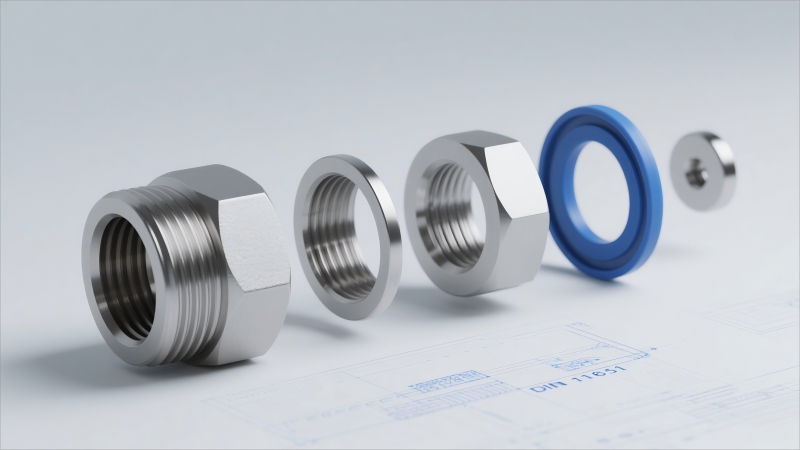
Behind every efficient and immaculate fluid processing line lies a network of hundreds, if not thousands, of reliable connections. From food processing and beverages to pharmaceuticals and biotechnology, the integrity of every valve, pump, and pipe union is paramount. Today, we take a deep dive into a time-honored and globally trusted standard in the world of hygienic applications: DIN 11851, often known as the "Hygienic Screwed Union" or "Dairy Coupling."
1. What is DIN 11851 & Why is it Crucial?
DIN 11851 is a standard established by the German Institute for Standardization (Deutsches Institut für Normung) for hygienic screw pipe couplings. Originally designed for the dairy industry, its purpose was to create a reliable connection that was easy to disassemble, clean, and maintain, ensuring the highest level of sanitation.
Thanks to its brilliant design and reliability, the use of DIN 11851 quickly expanded beyond dairy. It has become one of the most widely used threaded connection standards in Europe and across the globe for industries like food processing, brewing, beverage production, and pharmaceuticals. Choosing fittings compliant with DIN 11851 means you are opting for a proven, secure, and cost-effective solution for your process lines.
2. Anatomy of a DIN 11851 Union: The "Golden Quartet"
A complete DIN 11851 union consists of four essential components, each with a specific function:
-
Male Part (Gewindestutzen): Typically welded onto a pipe or equipment port. It features a distinctive round thread, which is less prone to damage and product buildup, making it easier to clean.
-
Liner (Einlegestutzen): This part is welded to the connecting pipe. Its smooth internal surface and precise sealing face are key to maintaining hygienic conditions.
-
Slotted Nut (Nutmutter): This is the locking mechanism that securely fastens the Male Part and Liner together. The slots on its exterior allow for easy and uniform tightening or loosening with a hook spanner (C-spanner), facilitating quick maintenance and CIP (Clean-in-Place) procedures.
-
Gasket (Dichtring): This is the heart of the seal. It fits perfectly into a specially designed groove between the Male Part and the Liner, creating a smooth, crevice-free seal. We offer a range of materials, including EPDM, NBR, Viton, and Silicone, to suit various operating temperatures, pressures, and chemical media.
[An exploded-view diagram of a DIN 11851 union, clearly showing the four parts, would be perfect here.]
3. Why Do Industry Leaders Worldwide Trust DIN 11851?
-
Superior Hygienic Design: The connection provides a smooth, flush internal surface with no crevices, effectively preventing bacterial growth and ensuring full compliance with CIP and SIP (Sterilize-in-Place) protocols.
-
Reliable Sealing Performance: The precision design, combined with a high-quality gasket, guarantees a durable, leak-proof seal, even under pressure and temperature fluctuations.
-
Ease of Installation & Maintenance: The union can be quickly assembled and disassembled without complex tools, significantly reducing production downtime and improving operational efficiency.
-
Durability & Cost-Effectiveness: Its robust construction and widespread adoption make it a highly economical choice with an excellent return on investment.
4. A Common Pitfall: DIN 11851 vs. SMS 1145
A word of caution! Although they may look similar, the DIN 11851 standard and the Swedish SMS 1145 standard are NOT interchangeable. There are critical, albeit subtle, differences in their thread pitch, diameters, and gasket dimensions. Mixing these components will lead to unstable connections, seal failure, and potentially severe safety and contamination risks. As a professional manufacturer, we strongly advise you to confirm the required standard before purchasing to avoid costly mistakes.
5. Our Promise: More Than Manufacturing, We Provide Solutions
Understanding the standard is the first step. Choosing a trustworthy supplier is the key to ensuring your production line operates safely and efficiently.
At our company, we understand the importance of every detail. Our range of DIN 11851 compliant hygienic valves, pumps, high shear mixers, and pipe fittings are not just made to standard; they are engineered to elevate it:
-
Premium Materials: We insist on using high-grade SS304 and SS316L stainless steel to guarantee exceptional corrosion resistance and durability.
-
Precision Engineering: We utilize state-of-the-art CNC machining to ensure every thread and sealing surface meets micrometer-level precision for a perfect fit.
-
Rigorous Quality Control: From raw material inspection to final product dispatch, every item undergoes a multi-stage inspection process to ensure consistent, reliable performance.
-
Comprehensive Application Support: Our product portfolio covers everything from tubes, elbows, and tees to ball valves, butterfly valves, diaphragm valves, and a variety of hygienic pumps, offering you a one-stop fluid handling solution based on the DIN 11851 standard.
Conclusion
The DIN 11851 standard is more than just a technical specification; it represents a commitment to hygiene, safety, and efficiency. It acts as a reliable partner, working silently in the background to safeguard the superior quality of your final product.
Planning a new project and need a dependable hygienic connection solution? Or perhaps you're looking to upgrade your current process line?
Contact us today. Our team of experts would be delighted to share more insights on DIN 11851 and other hygienic standards, and to help you find the most suitable and cost-effective product solutions for your specific application in the food, beverage, pharmaceutical, or cosmetics industry.
[Click Here to Contact Us / Visit our Website at www.sangyie.com / Email us at [info@sangyie.com]
Sangyie Technology — Engineering the Flow of Your Success.
When the pump is installed above the liquid level, which type ensures reliable and efficient operation?
The Definition of Gentle: How Sine Pumps Minimize Shear to Protect Your Most Sensitive Product
Related Article

DIN 11866 is the overarching standard for aseptic systems that uses DIN 11850 as its "Series A" option.