Standard comparison of 316L stainless steel: EN1.4404 vs EN1.4435
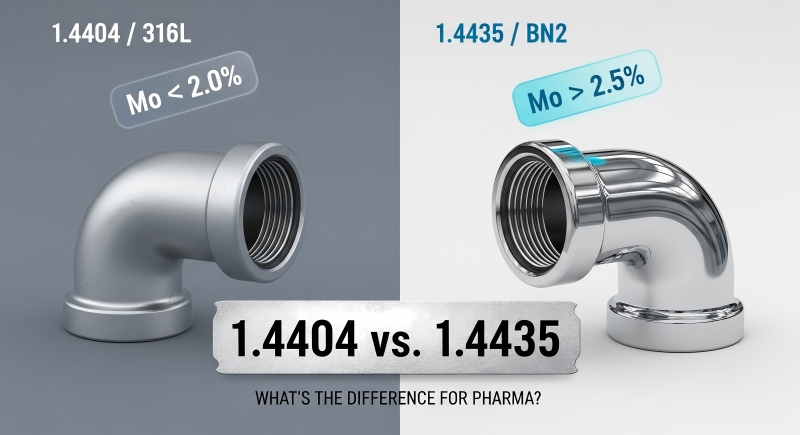
1.4435 is an upgraded version of 1.4404, featuring "high molybdenum and high nickel" content, and exhibiting stronger corrosion resistance and purer austenite structure.
1. Comparison of chemical composition (based on EN 10088-3)
Chemical Composition (%)
(Per EN 10088-3 standards)
| Element | EN 1.4435 | EN 1.4404 | Key Differences |
|---|---|---|---|
| Carbon (C) | ≤0.030% |
≤0.030% |
Same (Low carbon) |
| Silicon (Si) | ≤1.00% |
≤1.00% |
Same |
| Manganese (Mn) | ≤2.00% |
≤2.00% |
Same |
| Phosphorus (P) | ≤0.045% |
≤0.045% |
Same |
| Sulfur (S) | ≤0.015% |
≤0.015% |
Same (Low sulfur for better polishability) |
| Chromium (Cr) | 17.0 - 19.0% | 16.5 - 18.5% | EN 1.4435 is slightly higher. |
| Molybdenum (Mo) | 2.50 - 3.00% | 2.00 - 2.50% | CRITICAL DIFFERENCE: EN 1.4435 has higher Mo for better corrosion resistance. |
| Nickel (Ni) | 12.5 - 15.0% | 10.0 - 13.0% | CRITICAL DIFFERENCE: EN 1.4435 has higher Ni for a more stable austenitic structure. |
| Nitrogen (N) | ≤0.11% |
≤0.11% |
Same |
2. Corrosion resistance (PREN value)
Pitting Resistance Equivalent Number (PREN) is an important indicator for measuring the resistance of stainless steel to localized corrosion (pitting).
-
1.4404: Since the molybdenum content is typically around 2.0-2.3%, its PREN value is usually between 23 - 26
-
1.4435: Due to a guaranteed minimum molybdenum content of 2.5%, its PREN value is typically between 26 - 29.
Conclusion: 1.4435 exhibits significantly superior corrosion resistance to 1.4404 in environments containing chloride ions (such as saltwater, physiological saline), organic acids, and reducing acids.
3. The Delta Ferrite Issue
-
The role of nickel: Nickel is an austenite stabilizing element. The nickel content of 1.4435 is higher (up to 15%), which makes its microstructure more stable and presents a fully austenitic state.
-
Ferrite content:
-
1.4404 may retain a small amount of residue after solidification ferrite.
-
1.4435 is extremely easy to control to achieve zero ferrite or very low ferrite content (<0.5%).
-
Why is low Delta Ferrite important?
-
Electropolishing: Low ferrite allows for a smoother, mirror-like surface finish (Ra < 0.4µm), essential for ASME BPE standards.
-
Rouging: Ferrite particles can act as initiation sites for "rouging" (reddish surface rust) in high-purity water (WFI) systems.
4. Which Grade Should You Choose?
As a manufacturer of sanitary fluid equipment, we recommend materials based on your specific application:
Choose 1.4404 (AISI 316L) for:
-
Food & Beverage: Dairy processing, brewing, soft drinks.
-
Personal Care: Lotions, soaps, shampoo manufacturing.
-
Standard Utilities: Compressed air, pre-filtration water.
-
Verdict: It is cost-effective and perfectly sanitary for non-aggressive media.
Choose 1.4435 (BN2 / ASME BPE) for:
-
Pharmaceuticals: API manufacturing, injectable drugs.
-
Biotechnology: Cell culture media, bioreactors.
-
Semiconductors: Ultra-high purity chemical distribution.
-
WFI Systems: Water for Injection loops where rouging is a major concern.
5. Our Commitment to Material Quality
At Sangyie, innovation is in our DNA. Whether you need a sanitary butterfly valve for a dairy plant or a high-shear mixer for a vaccine production line, we provide full material traceability.
-
Certified Materials: We provide EN 10204 3.1 material certificates confirming the exact chemical composition of our valves and fittings.
-
ASME BPE Compliance: Our pharma-line products meet strict dimensional and surface finish requirements (SF1, SF4).
-
Custom Solutions: We can manufacture utilizing specific 1.4435 heats with controlled ferrite levels (<0.5% or <3%) upon request.
[Click Here to Contact Us / Visit our Website at www.sangyie.com / Email us at [info@sangyie.com]
Sangyie Technology — Engineering the Flow of Your Success.
What are Sanitary Fittings? The Essential Guide for Hygienic Processing
Achieving Hygienic Design: 5 Non-Negotiable EHEDG Requirements for Sanitary Valve and Pump Construction
Related Article

DIN 11866 is the overarching standard for aseptic systems that uses DIN 11850 as its "Series A" option.